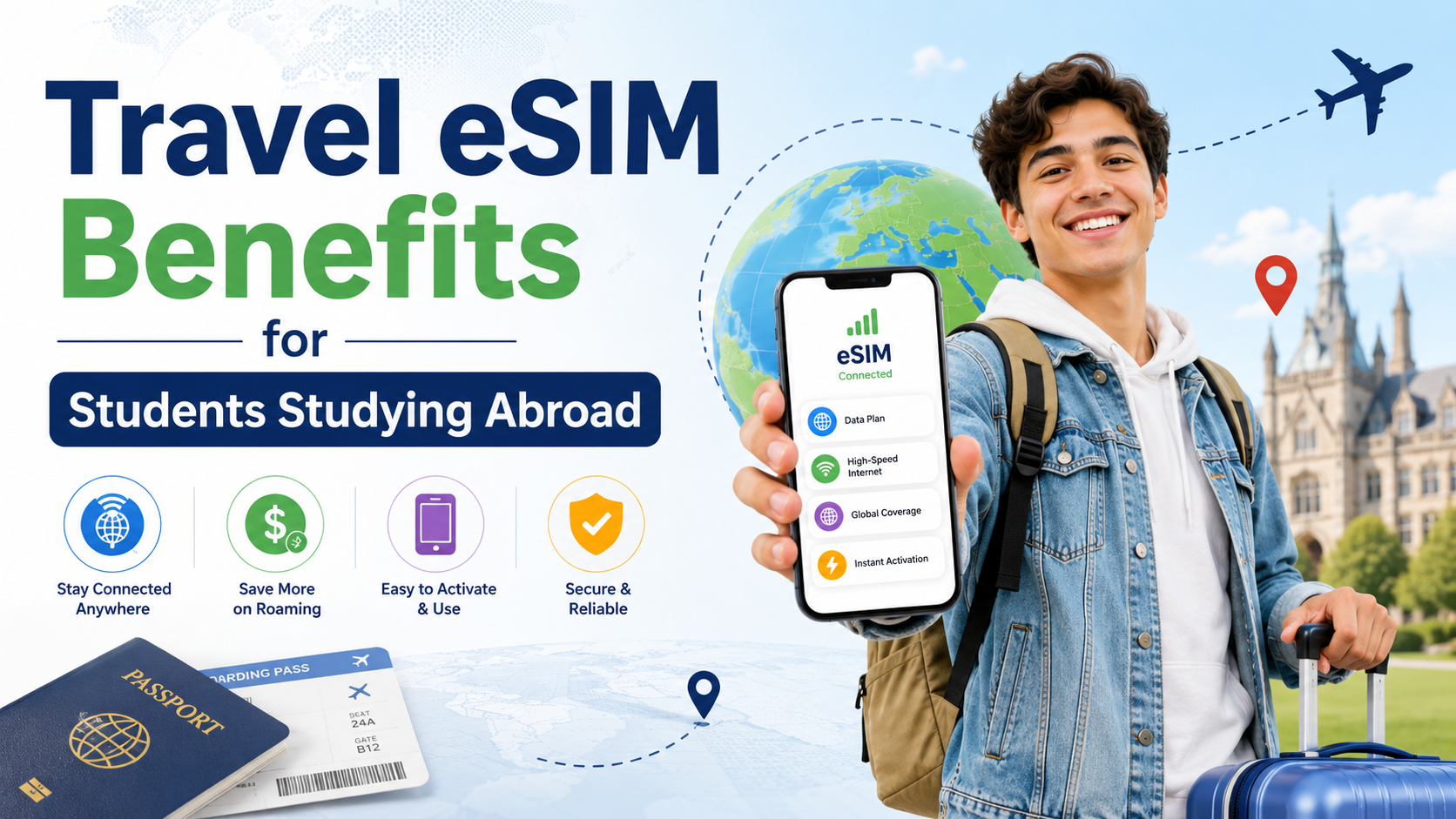
Studying abroad is exciting, but it also comes with a long list of practical challenges. New city. New campus. New transport routes. New banking apps. New emergency contacts. New group chats. For most students, mobile data becomes one of the first things they need after landing.
A few years ago, staying connected abroad usually meant paying high roaming charges, buying a local SIM card, or waiting until campus Wi-Fi was available. None of those options are ideal when a student needs to message family, book transport, open maps, contact accommodation, or verify a banking app within the first hour of arrival.
This is where a travel eSIM becomes useful. It gives students mobile data without removing their physical SIM card, visiting a phone shop, or dealing with complicated roaming packages. For students studying abroad, that convenience can make the first few days smoother and the entire semester easier to manage.
In this guide, we’ll look at the main travel eSIM benefits for students studying abroad and why this small digital tool can make a big difference in daily student life overseas.
What Is a Travel eSIM?
A travel eSIM is a digital SIM that can be installed directly on a compatible smartphone. It works like a regular SIM card, but there is no plastic card to insert into the phone. Students usually buy a plan online, receive setup details by email, scan a QR code, and activate mobile data when they arrive at their destination.
The biggest difference is convenience. A physical SIM card requires a store visit, ID checks in some countries, language confidence, and sometimes a local address. A travel eSIM can often be arranged before the flight, which means students can land with data ready to use.
For students who are already managing visas, packing, documents, housing, tuition payments, and travel planning, having one less thing to sort out after arrival is a real advantage.
1. Students Can Get Connected as Soon as They Land
The first few hours in a new country can feel overwhelming. Students may need to find their airport transfer, message a landlord, check train platforms, open Google Maps, translate signs, or call a family member to say they arrived safely.
Without mobile data, all of that depends on airport Wi-Fi. Airport Wi-Fi may be slow, crowded, limited, or require SMS verification. That is not something students should rely on when they are tired, carrying luggage, and trying to reach accommodation on time.
A travel eSIM allows students to turn on data as soon as they land. This makes arrival less stressful and gives them instant access to the tools they already use every day. Maps, rideshare apps, university emails, messaging apps, and banking apps all become available without waiting for a local SIM card.
For students heading to busy study destinations such as the USA, UK, Canada, Australia, France, Germany, Italy, Spain, or Japan, this immediate connection can make the arrival process far easier.
2. It Reduces the Risk of Expensive Roaming Charges
Roaming charges can be one of the most unpleasant surprises for students abroad. Many students assume they will only use data for a few quick messages, then later discover that maps, app updates, cloud backups, social media, and background notifications used more data than expected.
A travel eSIM gives students more control. They can choose a data plan before leaving, understand the cost upfront, and avoid relying on their home carrier’s international roaming rates. This matters because student budgets are usually tight. Rent, groceries, transport, books, visa fees, and social activities already add up quickly.
When mobile data is planned in advance, students can avoid bill shock and manage their spending with more confidence. For students who want a simple place to start, checking travel eSIM plans for international students before departure can be a practical step during pre-travel planning.
The goal is not just cheaper data. The bigger benefit is predictability. Students know what they are paying for, how much data they have, and when they may need to top up or adjust usage.
3. Students Can Keep Their Home SIM Active
One of the biggest problems with buying a physical SIM abroad is that students often need to remove their home SIM card. That can create problems with banking, university logins, two-factor authentication, family calls, and important text messages.
A travel eSIM allows many students to keep their physical SIM in the phone while using the eSIM for data abroad. This is useful because many apps still rely on the home number for verification. Banks, government portals, student finance accounts, email accounts, and university systems may send codes to the original phone number.
Keeping the home SIM in place also reduces the risk of losing it. A tiny SIM card is easy to misplace in a wallet, suitcase, or desk drawer. Losing it while abroad can become a serious problem, especially if the student needs that number for account recovery.
With an eSIM, students can use international data while keeping their main number available where needed. It is a cleaner setup for long stays, semester exchanges, and multi-country study programs.
4. It Saves Time During an Already Busy Move
Moving abroad for study is not like taking a short holiday. Students may arrive with academic deadlines, orientation events, accommodation check-ins, health insurance requirements, bank appointments, and campus registration tasks.
Finding a local SIM card should not become another stressful errand. In many countries, buying a physical SIM may involve queues, passport checks, forms, unfamiliar mobile providers, and plan comparisons in another language. Some airport SIM counters also charge tourist-focused prices, which may not be ideal for students staying longer.
A travel eSIM saves time because it can be arranged before departure. Students can install it at home while connected to Wi-Fi, check that everything is ready, and activate it when needed. This makes the first week more manageable.
For parents, this also brings peace of mind. They know the student can contact them after landing without depending on public Wi-Fi or finding a mobile shop immediately.
5. It Supports Safer Travel and Daily Movement
Safety is one of the strongest reasons students need reliable mobile data abroad. A connected phone is not only for social media or entertainment. It supports personal safety in practical ways.
Students use mobile data to check safe routes, share live locations, call rideshare services, translate instructions, contact emergency services, and message friends when returning home late. They may also need quick access to university security contacts, accommodation staff, or local transport alerts.
In an unfamiliar city, being offline can make small problems feel bigger. A missed train, wrong bus stop, closed metro line, or lost wallet becomes harder to handle without data.
A travel eSIM gives students access to digital tools that support safer movement. It cannot remove every risk, but it gives students more control when they are learning a new city.
6. It Makes Multi-Country Study Travel Easier
Many students studying abroad do not stay in one place for the entire semester. Students in Europe may travel between countries on weekends. Exchange students may attend conferences, internships, competitions, or short academic trips. Some students also visit family or friends in nearby destinations during breaks.
With physical SIM cards, crossing borders can create new connectivity problems. A local SIM might work well in one country but become expensive or limited in another. Students may need to buy another SIM or change settings each time they travel.
A travel eSIM can make multi-country movement simpler, especially when regional or global plans are available. Students can choose a plan that suits their route and avoid the repeated process of buying local SIM cards in every country.
This is especially useful for students on Erasmus-style programs, international internships, research exchanges, or gap-year study routes where travel is part of the experience.
7. It Works Well for Online Learning and Campus Life
University life now depends heavily on digital access. Students use learning portals, class schedules, email, group chats, digital ID apps, online libraries, cloud documents, and video calls. Even when campus Wi-Fi is available, students still need mobile data between classes, on public transport, in cafés, during fieldwork, or while moving between accommodation and campus.
A travel eSIM gives students a backup connection when Wi-Fi is weak or unavailable. This can be useful during orientation week, apartment hunting, campus tours, library visits, and exam periods.
It also supports hybrid study routines. Some students attend online tutorials, submit assignments, download reading material, or respond to group project messages while away from their accommodation. Having data available reduces missed updates and keeps academic tasks moving.
For students balancing classes, part-time work, and social life, that flexibility matters.
8. It Can Be Easier for Parents and Families Too
Studying abroad is a major step for students, but it can also be emotional for families. Parents want to know their child arrived safely, settled into accommodation, and can reach someone if there is a problem.
A travel eSIM makes communication easier from day one. Students can message home from the airport, send location updates, make app-based calls, and stay available during the first few days of adjustment.
This can be especially helpful when students are moving across time zones. Quick updates through WhatsApp, FaceTime, Messenger, or similar apps can reduce worry without relying on international calling plans.
Families may also prefer this setup because it is simple to understand. The student keeps the usual phone, installs a digital travel plan, and uses data abroad. There is no need to explain local SIM cards, new numbers, or complicated roaming add-ons.
9. It Reduces Dependence on Public Wi-Fi
Public Wi-Fi can be helpful, but students should not depend on it for everything. Free Wi-Fi in airports, cafés, train stations, and public areas may be slow, unstable, or less secure. It may also require sign-ups, local phone verification, or repeated logins.
A travel eSIM gives students private mobile data when they need to access sensitive accounts. This is useful for banking apps, student finance portals, passport-related documents, university systems, and email accounts.
Students should still use good digital safety habits, such as strong passwords, two-factor authentication, and secure connections. But having mobile data reduces the need to connect to random public Wi-Fi networks just to complete basic tasks.
For students managing money, documents, and academic accounts abroad, that extra layer of control is valuable.
10. It Is a Cleaner Option for Short-Term and Long-Term Students
Some students study abroad for four years. Others travel for one semester, one summer school, a language course, an internship, or a short exchange. A travel eSIM can suit both situations, depending on the plan and destination.
For short-term students, it avoids the hassle of buying a local SIM for only a few weeks. For long-term students, it can cover the arrival period while they compare local mobile options calmly. They do not need to rush into the first plan they see at the airport.
This makes a travel eSIM a practical bridge. It gives students data immediately, then leaves them free to decide later whether they need a local long-term plan, a campus-related package, or continued travel eSIM use.
That flexibility is useful because every student’s situation is different. A student in London may need a different setup from a student in Tokyo, Madrid, Toronto, Sydney, or Berlin.
11. It Makes Phone Setup Less Complicated
Travel planning already involves too many small details. Visa documents, accommodation contracts, tuition payments, insurance papers, prescription medicines, plug adapters, luggage rules, and bank cards can all demand attention.
A travel eSIM keeps phone setup simple. Students do not need a SIM ejector tool, a physical store, or a new plastic card. In many cases, they only need a compatible phone, Wi-Fi for setup, and the QR code or activation details from the provider.
Before buying, students should always check device compatibility. Not every phone supports eSIM, and some phones may be locked to a carrier. It is better to confirm this before travel rather than discovering the issue after landing.
Once compatibility is confirmed, the process is usually straightforward enough for students to handle on their own.
12. It Supports Budget Control Through Data Awareness
Students often underestimate how much data they use abroad. Navigation, video calls, reels, music streaming, translation apps, and automatic cloud backups can use data quickly.
A travel eSIM can encourage better data habits. Since the plan is selected in advance, students become more aware of their usage. They can download offline maps, use campus Wi-Fi for large files, turn off automatic updates, reduce video quality, and monitor data through phone settings.
This kind of control is useful for students trying to manage monthly expenses. It also teaches practical travel habits that can be useful beyond university life.
Students who travel frequently during their study period may also compare destination-based, regional, and global plans to find what fits their route. A simple starting point is to compare student-friendly eSIM options before you fly so the data plan matches the destination, length of stay, and expected usage.
How Students Should Choose a Travel eSIM
Before choosing a travel eSIM, students should look at a few practical details. First, check whether the phone supports eSIM and is unlocked. Second, compare coverage for the destination country or region. Third, review the data amount and validity period. Fourth, check whether hotspot use is allowed if the student plans to connect a laptop or tablet.
Students should also think about how they will use mobile data. A light user who mostly needs maps and messaging may need less data. A student who uses video calls, streaming, remote classes, and hotspot sharing may need a larger plan.
It is also smart to install the eSIM before leaving home while connected to reliable Wi-Fi. Students should save the QR code, read the setup instructions, and understand which SIM should be used for data after arrival. This avoids confusion at the airport.
Common Mistakes Students Should Avoid
The first mistake is assuming that campus Wi-Fi will be enough. It may work well on campus, but students still need data while traveling, shopping, commuting, or handling paperwork.
The second mistake is leaving mobile data roaming on without checking the cost. This can lead to unexpected charges from the home carrier.
The third mistake is buying a plan without checking device compatibility. A travel eSIM only works on phones that support eSIM and are not restricted by a carrier lock.
The fourth mistake is using too much data on automatic app updates, cloud backups, or high-quality video streaming. Students should adjust settings before travel to make the plan last longer.
The fifth mistake is waiting until arrival to solve everything. Studying abroad is easier when key details are handled before departure. Mobile data should be one of them.
Final Thoughts
For students studying abroad, mobile data is not a luxury. It is part of safe travel, academic access, daily communication, budgeting, and independence. A travel eSIM gives students a practical way to stay connected without relying on expensive roaming, public Wi-Fi, or airport SIM counters.
The biggest benefits are simple but important. Students can connect when they land, keep their home SIM active, manage costs better, move around more safely, and stay ready for campus life from the first day.
Studying abroad will always involve some uncertainty. That is part of the experience. But staying connected should not be one of the difficult parts. With the right travel eSIM, students can arrive prepared, settle in faster, and focus more energy on the reason they went abroad in the first place: learning, growing, and experiencing a new part of the world.
