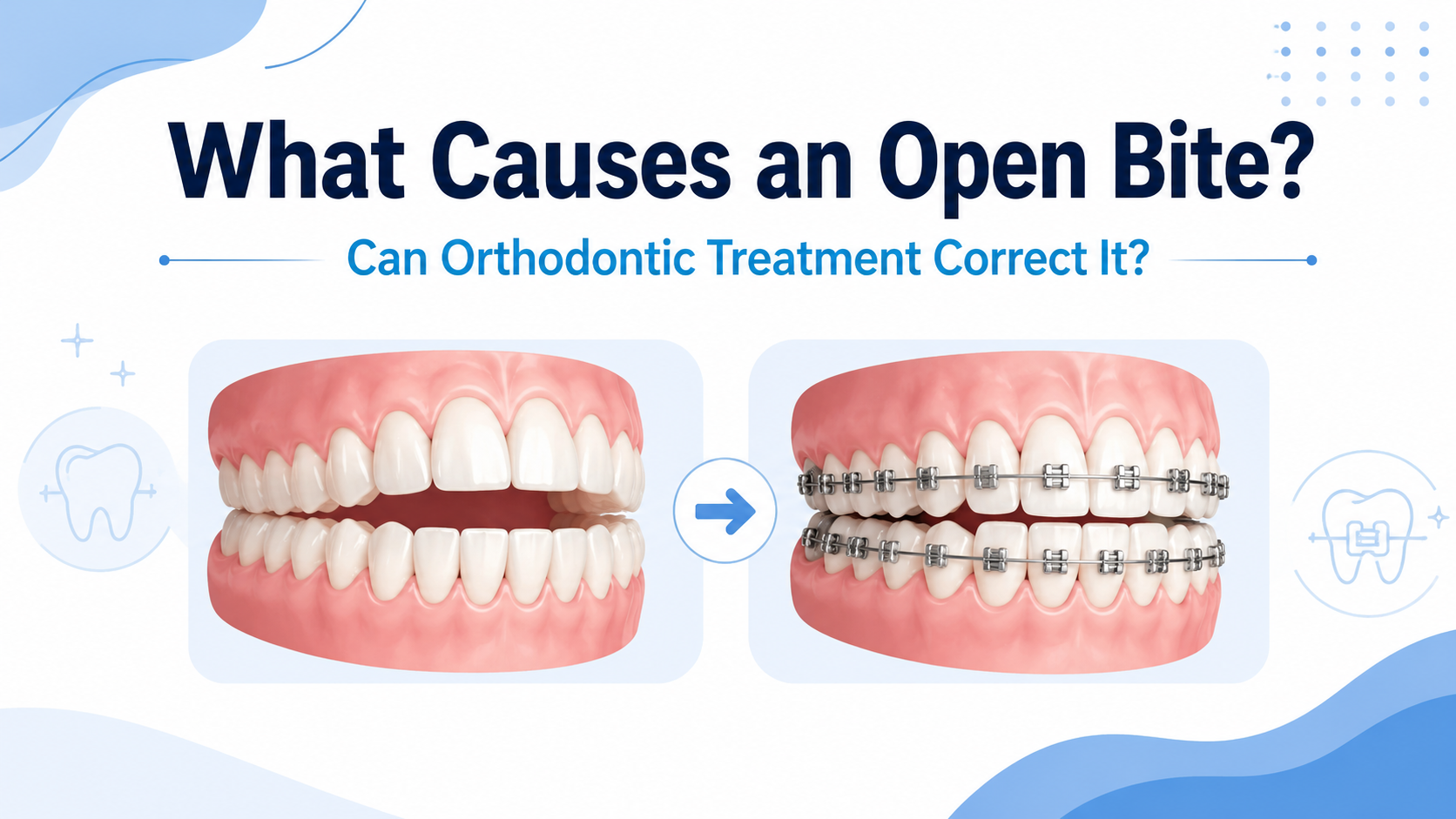
An open bite can look like a simple gap between the upper and lower teeth, but the reason behind it is often more complex. In some people, the front teeth do not touch when the mouth closes. In others, the opening appears farther back. Depending on its severity, an open bite may affect biting, chewing, speech, swallowing, and the way pressure is distributed across the teeth.
Many open bites can be improved with orthodontic treatment. The right approach depends on why the bite developed, the patient’s age, jaw growth, tooth position, and whether habits or muscle patterns are still influencing the teeth.
What Is an Open Bite?
An open bite is a type of malocclusion, meaning the upper and lower teeth do not meet in the expected way when the jaws close.
The most common form is an anterior open bite. The back teeth may touch while a visible space remains between the upper and lower front teeth. A posterior open bite occurs when some back teeth do not contact even though the front teeth may meet.
A larger open bite can make it difficult to bite through foods with the front teeth or create uneven contact elsewhere in the mouth. Orthodontists therefore consider the teeth, jaws, facial growth, tongue posture, and oral habits rather than focusing only on the visible gap.
What Causes an Open Bite?
Open bites are often multifactorial, which means more than one influence may be involved.
Jaw Growth and Genetics
Some people naturally develop a facial or jaw growth pattern that makes an open bite more likely. The jaws may grow in a more vertical direction, or the relationship between the upper and lower jaw may keep the front teeth from meeting normally.
When jaw structure is a major factor, the condition is often described as a skeletal open bite. Genetics can also influence jaw size, facial proportions, and bite relationships.
Thumb Sucking and Pacifier Use
Thumb or finger sucking is common in young children, but a strong habit that continues while the teeth and jaws are developing can affect the bite. Repeated pressure may move the front teeth or influence the shape of the dental arches.
Long-term pacifier use can have a similar effect. The impact depends on how often the habit occurs, how long it continues, and how much pressure is applied. If it stops early enough, some improvement may occur naturally as growth continues.
Tongue Posture and Swallowing Patterns
In some people, the tongue rests farther forward or moves between the front teeth during swallowing. This is commonly called tongue thrusting.
A forward tongue pattern may contribute to an open bite or make an existing one harder to correct. In other cases, the tongue may adapt to a space that developed for another reason, so it should be assessed as part of the full bite.
Mouth Breathing and Airway Factors
Chronic mouth breathing may be associated with changes in tongue position, lip posture, and facial growth. Nasal obstruction, enlarged tonsils, allergies, or other airway concerns may sometimes be part of the picture.
Mouth breathing does not automatically cause an open bite, but further evaluation may be useful when breathing patterns appear to affect oral posture or growth.
Tooth Eruption Problems
Some open bites develop because certain teeth do not erupt to the expected height. Eruption disturbances, ankylosed teeth, missing teeth, or other local dental issues can prevent opposing teeth from making proper contact. These factors can be especially important in posterior open bites.
Why Can an Open Bite Be More Than a Cosmetic Concern?
An open bite may affect function as well as appearance. When some teeth do not meet, other teeth can take more of the biting load.
People with an anterior open bite may struggle to bite cleanly into foods such as sandwiches, apples, or pizza. Some compensate by tearing food or relying more heavily on their back teeth.
Speech may also be affected, particularly sounds that depend on precise tongue placement. Some people notice a lisp or air escaping through the opening. Swallowing patterns can change too, especially when the tongue repeatedly moves into the gap.
How Is an Open Bite Diagnosed?
Diagnosis usually begins with an examination of how the upper and lower teeth fit together. The orthodontist may also evaluate facial proportions, jaw position, tooth eruption, lip posture, and the resting position of the tongue.
Photographs, digital scans, and dental X-rays can provide additional information. In younger patients, the orthodontist also considers how continued growth may affect the jaws.
Two open bites can look similar but require very different treatment. A child with a persistent sucking habit may need a different plan from an adult whose open bite is primarily related to jaw structure.
Readers who want to learn more about the types of care used for bite and alignment concerns can explore orthodontic treatment for children, teens, and adults before deciding what questions to ask during an evaluation.
Can Braces Correct an Open Bite?
Braces can correct many open bites. Brackets, wires, and sometimes elastics allow an orthodontist to move teeth gradually and improve the way the upper and lower arches meet.
Treatment may involve bringing front teeth into better contact, controlling the vertical position of back teeth, and coordinating several tooth movements at once.
Still, braces cannot compensate indefinitely for an active habit or muscle pattern. If thumb sucking continues or the tongue repeatedly pushes between the teeth, those forces may work against treatment and raise the possibility of relapse.
For that reason, correcting an open bite often involves both moving the teeth and identifying anything that may continue placing unwanted pressure on them.
Can Clear Aligners Fix an Open Bite?
Clear aligners can also be used in many open-bite cases. Modern aligner treatment can move teeth vertically as well as horizontally, and attachments or elastics may be added when more control is needed.
Aligners appeal to many teens and adults because they are removable and less noticeable than fixed braces.
However, the best appliance is not decided by appearance alone. The orthodontist needs to determine whether aligners can produce the specific movements required for that bite. Successful treatment also depends on wearing the trays as directed.
A relatively mild dental open bite may require different mechanics from an open bite involving significant jaw growth differences. This is why seeing similar-looking before-and-after cases online cannot reliably tell someone whether aligners will work for their own bite.
When Is Early Treatment Helpful?
Timing matters in children because the teeth and jaws are still developing. If an open bite is related to thumb sucking, pacifier use, tooth eruption, or a developing jaw relationship, early evaluation may identify the cause before the problem becomes more established.
Sometimes the first step is simply monitoring growth and helping a child stop a habit. In other cases, an orthodontic appliance may be recommended. Early evaluation does not mean braces must begin immediately.
The goal is to decide whether intervention during growth could improve development or make later treatment simpler. Families looking for a local evaluation can also review information about orthodontic care in North Canton, Ohio when considering where to discuss a developing bite concern.
Do Adults With Open Bites Need Jaw Surgery?
Not always. Many adult open bites can be treated with braces, clear aligners, elastics, or other orthodontic techniques. In selected cases, temporary anchorage devices, commonly called TADs, can provide additional control over vertical tooth movement.
Corrective jaw surgery may be considered when a severe open bite is caused mainly by a skeletal discrepancy that cannot be corrected predictably by moving the teeth alone. This is more commonly discussed after facial growth is complete.
If surgery is appropriate, orthodontic treatment is usually coordinated with an oral and maxillofacial surgeon. Surgery is one possible option, not the default solution for every adult open bite.
A careful diagnosis is particularly important for adults because moving teeth can sometimes disguise part of a jaw discrepancy without actually correcting the underlying skeletal relationship. The orthodontist therefore needs to determine what can realistically be accomplished with tooth movement alone.
Why Does the Cause Matter After the Bite Is Corrected?
Closing the space is only part of successful treatment. Long-term stability also depends on controlling the forces that contributed to the problem.
If a sucking habit continues, the tongue repeatedly pushes between the teeth, or an airway-related issue continues to affect oral posture, the bite may be more likely to reopen. Depending on the case, an orthodontist may coordinate care with a dentist, speech-language pathologist, myofunctional therapist, ear, nose and throat specialist, or oral surgeon.
Retention is important as well. Retainers help hold the teeth in their corrected positions while the surrounding tissues adapt. The type of retainer and wearing schedule should be individualized.
This part of treatment is easy to overlook because the most visible change happens while braces or aligners are being worn. However, maintaining the corrected bite is an important part of the overall orthodontic plan, particularly when the original problem involved several contributing factors.
Can an Open Bite Correct Itself?
A mild dental open bite in a young child may improve after a sucking habit stops, particularly while growth is still occurring. It is difficult, however, to predict how much spontaneous correction will happen for a particular child.
An open bite that remains as permanent teeth erupt, becomes more noticeable, or causes functional problems should be evaluated. Adults should not expect an established open bite to close on its own because meaningful correction usually requires planned movement of the teeth, the jaws, or both.
Waiting can also make it harder to understand whether a child’s bite is improving naturally or whether the underlying pattern is becoming more established. Periodic orthodontic monitoring can help distinguish between the two.
When Should You Ask an Orthodontist About an Open Bite?
An evaluation may be worthwhile when the front teeth do not touch while the back teeth are together, biting through food is difficult, speech seems affected, a child has a persistent thumb or pacifier habit, the tongue frequently rests between the teeth, or the bite appears to be changing over time.
An evaluation does not automatically mean treatment must begin immediately. Monitoring may be appropriate, particularly in a growing child. The goal is to identify the cause and decide whether treatment timing matters.
Adults should also consider an evaluation when an open bite affects comfortable chewing or has become more noticeable. Age alone does not determine whether orthodontic correction is possible. The condition of the teeth, gums, supporting bone, and jaws is generally more important when planning treatment.
Final Thoughts
An open bite can develop from jaw growth, genetics, prolonged oral habits, tongue posture, breathing patterns, or tooth eruption problems. Because the causes vary, treatment should be based on more than the appearance of the gap.
Braces and clear aligners can correct many open bites. Some patients may also benefit from early habit intervention, additional orthodontic mechanics, coordinated care with other professionals, or, in severe skeletal cases, jaw surgery.
The most useful first step is a careful orthodontic evaluation. Once the cause is understood, treatment can focus on more than closing a visible space. The larger goal is to create a bite that functions well and has the best possible chance of remaining stable over time.
