In today’s digital age, data is at the heart of every decision, system, and interaction. The world generates over 300 exabytes of data each day, and managing this information efficiently is more critical than ever. Businesses and individuals alike depend on reliable storage devices to keep operations running smoothly, whether that means hosting applications, protecting sensitive information, or maintaining high-speed access to files.
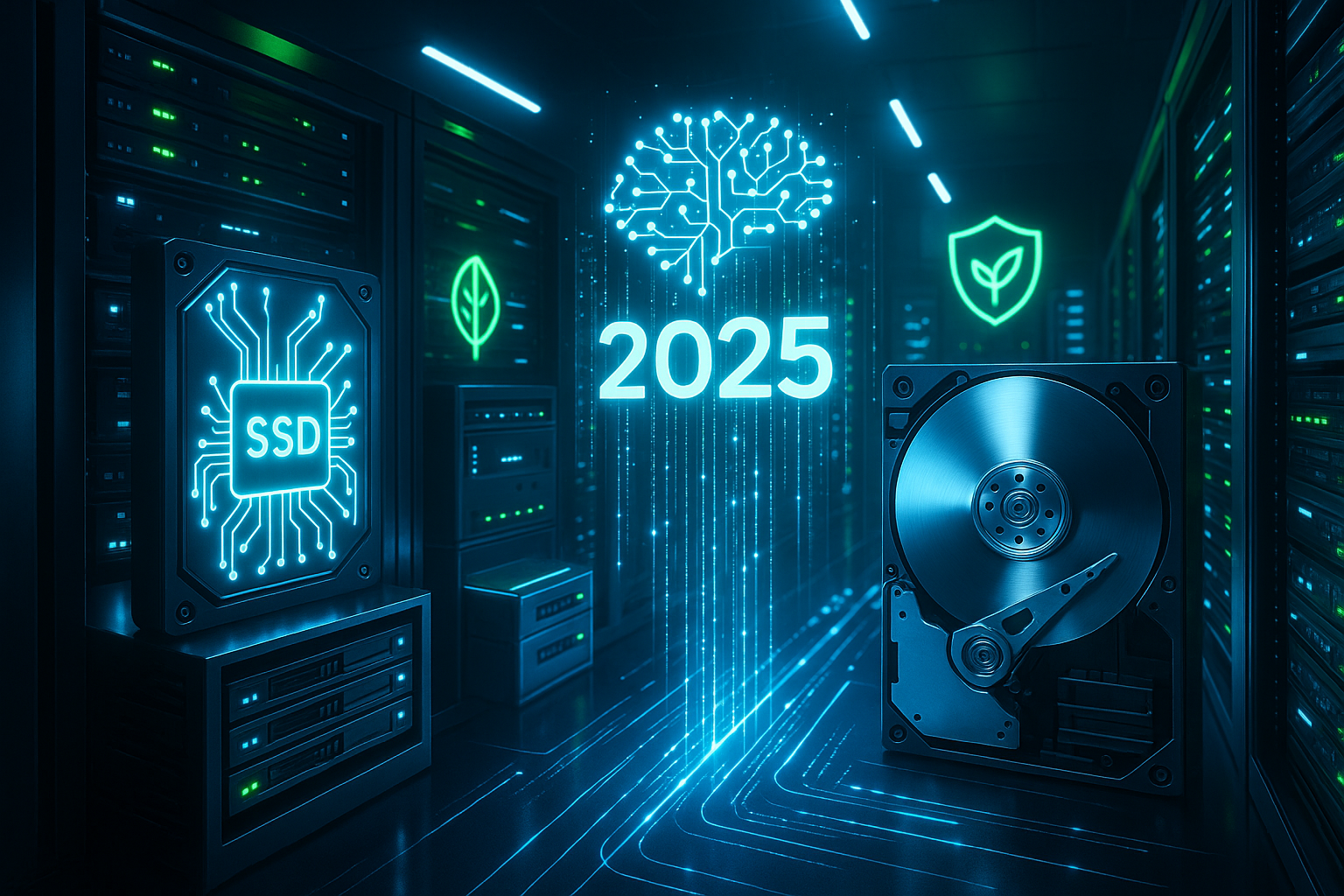
As we move into 2025, the storage market is witnessing significant shifts. Solid-state drives (SSDs) are pushing the limits of speed and durability, hard disk drives (HDDs) are holding strong in cost-per-capacity value, and hybrid approaches are bridging the gap to offer balance. Beyond these, advancements in artificial intelligence (AI), sustainability concerns, and data security are reshaping how storage is deployed and consumed.
This blog explores the present state and future of HDDs, SSDs, and hybrid solutions, along with trends that will dominate in 2025 and beyond.
HDDs: Still the Backbone of Bulk Storage
For decades, HDDs have been the primary workhorse of the storage world. Their mechanical design, while traditional, continues to serve a vital role.
Capacity and Cost Advantages
HDDs excel where massive storage capacity is required at the lowest possible price point. A modern internal hard drive can offer multiple terabytes of space for a fraction of the cost of SSDs. This makes them indispensable for archiving, backup solutions, and data centres that manage petabytes of rarely accessed information.
Technological Advancements in HDDs
Although the fundamental design of HDDs has not changed drastically, manufacturers continue to innovate:
- HAMR (Heat-Assisted Magnetic Recording): Enables higher areal density, increasing capacity per drive.
- Energy-assisted technologies: Reduce power draw, critical for enterprise-scale data centres.
- Improved reliability: Modern HDDs now feature better error correction and vibration resistance, extending their lifespan.
Use Cases in 2025
- Enterprises: Long-term archival storage and large datasets.
- Small businesses: Cost-effective local backup solutions.
- Individuals: Mass storage for photos, videos, and documents.
SSDs: Speed and Efficiency at Scale
SSDs have transformed the storage landscape, making mechanical delays a thing of the past. Their flash memory design allows near-instantaneous access to data, improving both performance and user experience.
Performance Benefits
Compared to HDDs, SSDs offer:
- Higher read/write speeds: Essential for boot drives, application hosting, and gaming rigs.
- Low latency: Critical for AI training and real-time workloads.
- Durability: With no moving parts, SSDs are less prone to mechanical failure.
NVMe and PCIe Interfaces
The adoption of NVMe over PCIe has unlocked new levels of speed. By 2025, NVMe 2.1 and PCIe 7.0 standards are paving the way for unprecedented throughput, enabling SSDs to handle workloads previously reserved for high-end servers.
Use Cases in 2025
- Enterprise AI and machine learning systems.
- Developers and gamers requiring rapid response times.
- Cloud environments delivering high-performance applications.
The increasing affordability of SSDs ensures that they are no longer confined to premium devices. Even mid-range laptops and desktops now ship with SSDs as standard, making them a default choice for everyday users.
Hybrid Storage Solutions: Bridging Performance and Capacity
Hybrid storage combines the strengths of SSDs and HDDs, offering both speed and scalability. This can be achieved through hybrid drives (SSHDs) or by using a two-tier system where an SSD handles frequently accessed files, and an HDD manages bulk storage.
Benefits of Hybrid Systems
- Cost-efficiency: Provides SSD-level speed without the high cost of all-flash setups.
- Balanced performance: Ensures fast access to critical files while accommodating large archives.
- Flexibility: Suitable for both businesses and consumers.
Use Cases in 2025
- Small and medium-sized businesses: Cost-effective servers that balance speed with large data requirements.
- Content creators: Large video files stored on HDDs while editing projects run from SSDs.
- Home users: Affordable setups for gaming, media libraries, and general computing.
Hybrid systems will remain an attractive option in 2025 for organisations and individuals seeking both speed and storage capacity without overspending.
The Role of External Hard Drives in Portability
While cloud storage is widespread, the need for offline, portable, and secure storage continues to grow. The external hard drive plays a vital role in personal and business backup strategies.
Why They Remain Relevant
- Portability: Easy to transport large volumes of data.
- Security: Provides an offline backup immune to cyber-attacks.
- Versatility: Works across multiple platforms and operating systems.
Future Outlook
As capacities grow and physical designs become more compact, external drives will maintain their role as a bridge between local and cloud storage. They are particularly useful for photographers, videographers, and professionals working in areas with limited internet connectivity.
AI Workloads and Storage Requirements
One of the biggest shifts in storage demand is driven by artificial intelligence. AI systems, particularly those using retrieval-augmented generation (RAG), require massive datasets and lightning-fast access to support training and inference.
- High-performance SSDs: Critical for handling training data and real-time queries.
- Hybrid cloud storage: Enables organisations to balance local speed with cloud scalability.
- Data resilience: Storage designed with redundancy to minimise downtime in mission-critical applications.
The growth of generative AI ensures that storage technologies will remain a key enabler of future innovation.
Sustainability in Storage Devices
With environmental concerns at the forefront, the storage industry is actively pursuing greener solutions.
Areas of Focus
- Energy efficiency: Reduced power consumption in SSDs and enterprise HDDs.
- Recyclable materials: Minimising electronic waste by improving recycling processes.
- Embodied carbon reduction: Designing drives with a smaller environmental footprint.
In 2025, sustainability is no longer a choice but a requirement for businesses and manufacturers competing in global markets.
Best Practices for Data Protection and Backup
Regardless of the device chosen, protecting data remains essential. The “3-2-1” backup rule continues to be a gold standard:
- 3 copies of data.
- 2 different media types.
- 1 copy stored offsite.
Combining cloud services, local NAS, and external drives ensures resilience against cyberattacks, natural disasters, and system failures.
Security Challenges in Portable Storage
Removable devices such as USB drives and portable HDDs are convenient but also vulnerable. Encryption and password protection are now standard features, while advanced drives integrate biometric security for added assurance. Organisations adopting strict device-control policies ensure portable storage remains secure against data breaches.
The Road Ahead: What to Expect Beyond 2025
Looking forward, the storage industry will continue to innovate with breakthroughs like:
- DNA data storage offering unimaginable capacities.
- All-flash data centres becoming mainstream.
- Integration with quantum computing requiring unprecedented speed and resilience.
While these may be on the horizon, for most businesses and individuals the choice in 2025 will still revolve around balancing HDD, SSD, and hybrid setups according to their needs.
Conclusion
The future of storage is a story of balance. HDDs continue to dominate cost-effective capacity, SSDs redefine performance, and hybrid solutions bring both worlds together. Add in external drives for portability, and businesses and individuals have a complete toolkit to manage the ever-growing mountain of data.
As 2025 unfolds, the challenge is not choosing a single technology, but combining the right mix of storage devices, strategies, and security measures to stay efficient, resilient, and ready for the digital demands of tomorrow.
