On many work sites, the equipment that receives the most attention is usually the equipment that looks the most impressive.
- Large machinery.
- Heavy barriers.
- Protective structures.
- Vehicles with flashing lights.
These are the things that people naturally associate with safety because they are visible, physical and often directly involved in the work being carried out.
However, some of the most important safety decisions on a site are often communicated by something much smaller.
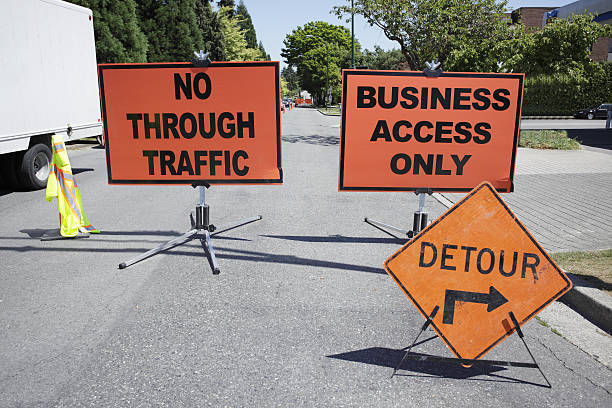
- A portable sign standing quietly at the entrance to a work area.
- A folding warning sign positioned beside a temporary hazard.
- A directional sign guiding people away from an unsafe route.
These items may only be in place for a few hours or a few days, but their short lifespan does not reduce their responsibility. In many situations, temporary signage carries one of the most important roles on site because it is responsible for communicating changes before people encounter them.
A barrier can physically prevent someone from entering an area.
A cone can create a visible boundary.
But a sign is often the first thing that changes behaviour.
It is the first warning.
The first instruction.
The first opportunity to prevent a mistake.
And that is why temporary does not mean unimportant.
In many cases, temporary signage carries the responsibility of protecting people before anything else has a chance to work.
The Equipment That Gets Noticed Is Not Always the Equipment That Communicates
There is an interesting contradiction in workplace safety. The products that appear the most important are often the products that people notice visually, while the products that influence behaviour are sometimes overlooked because their purpose is communication rather than physical protection.
A safety barrier is obvious because it creates separation.
A guardrail is obvious because it blocks access.
A machine guard is obvious because it prevents contact.
Portable signage works differently.
It does not physically stop someone from making the wrong decision.
Instead, it attempts to influence that decision before it happens.
That requires a different type of responsibility.
The sign needs to communicate clearly enough that a driver, pedestrian, contractor or visitor understands what has changed and what action they need to take before they reach the point where their options become limited.
This is why experienced safety professionals understand that temporary signs are not simply accessories placed around a site.
They are part of the site’s communication system.
The First Safety Conversation Often Happens Through a Sign
Before someone enters a construction area, walks through a warehouse, approaches a restricted zone or drives past a temporary road closure, there is usually a moment where they receive their first instruction.
That moment is often created by signage.
The sign may communicate:
“Do not enter.”
“Use another route.”
“Slow down.”
“Be aware of changing conditions.”
“Workers operating nearby.”
Although the message may only take a few seconds to read, those seconds can influence everything that happens afterwards.
A person who receives clear information early can adjust their behaviour naturally.
They can slow down.
They can change direction.
They can prepare themselves for a different environment.
A person who receives information too late is forced into a reaction.
And reactions, especially in busy environments, are where mistakes are more likely to happen.
Why Temporary Situations Often Require Better Communication Than Permanent Ones
Permanent hazards usually have one advantage that temporary hazards do not have.
Time.
A permanent safety feature remains in the same location and becomes part of the environment. People who regularly pass through that area become familiar with the layout and understand what to expect.
Temporary hazards are different because they introduce change.
A normal pedestrian route suddenly closes.
A vehicle access point moves.
A lane becomes unavailable.
A maintenance area appears where there was previously open space.
The challenge is not simply protecting people from the hazard itself.
The challenge is helping people understand that their normal behaviour no longer applies.
This is why temporary signage often carries such a significant responsibility.
It has to overcome familiarity.
It has to interrupt expectations.
It has to communicate change quickly.
A Temporary Sign Has a Very Small Window to Do a Very Important Job
Unlike permanent signs that people may see repeatedly, portable signs often have only one opportunity to communicate effectively.
A driver passing a roadwork area may never see that location again.
A visitor entering a facility may only be there once.
A contractor arriving at a temporary work zone may not understand the site’s normal layout.
The sign cannot rely on previous knowledge.
It must work immediately.
This creates an interesting challenge.
A portable sign must be simple enough to understand quickly, but important enough that people do not ignore it.
The message must compete against distractions, movement and the natural tendency people have to continue following familiar patterns.
Case Study: When a Temporary Hazard Became a Permanent Problem
Consider a warehouse undergoing a short-term renovation project.
The company planned for the obvious risks.
The construction area was separated.
Workers had protective equipment.
Materials were stored correctly.
However, the pedestrian route used by employees had changed, and the temporary pathway was not clearly communicated.
The problem was not a lack of safety equipment.
The problem was a lack of information.
Employees continued following their normal route because that was what they had done every day.
A simple temporary sign positioned at the correct decision point could have changed the entire situation.
The hazard was temporary.
The confusion was not.
This example highlights an important lesson: temporary conditions often create permanent consequences when people are not given enough information to adapt.
Portable Signs Are Designed Around Uncertainty
The biggest strength of portable signage is not simply that it can be moved. It is that it allows organisations to respond to uncertainty. Real workplaces rarely operate exactly as planned.
- A delivery area becomes congested.
- A maintenance issue appears unexpectedly.
- A walkway needs to be closed.
- A temporary restriction needs to be introduced.
In these moments, waiting for a permanent solution is not practical.
The environment has already changed.
The safety message needs to change with it.
Products such as Stromberg Folding Signs are valuable because they allow teams to quickly establish communication without requiring permanent installations or complicated setup procedures.
The ability to communicate quickly is often what separates a controlled temporary situation from a confusing one.
The Difference Between Warning People and Guiding People
One of the biggest misunderstandings about safety signs is that their only purpose is to warn.
Warning is important.
But effective temporary signage does more than announce a problem.
It guides behaviour.
A strong safety message does not simply tell people what is wrong.
It helps them understand what they should do next.
For example, a sign that says there is a hazard ahead creates awareness.
A sign that explains the safer alternative route creates direction.
The difference may appear small, but from a safety perspective, guidance is often more valuable than awareness alone.
People need information they can act on.
Why Good Temporary Signage Often Goes Unnoticed
There is an unusual measure of success in safety.
The best safety systems are often the ones nobody talks about.
When temporary signage works correctly, drivers slow down without thinking about it.
Workers follow the correct route naturally.
Visitors avoid restricted areas without needing additional intervention.
The system quietly influences behaviour.
This can make temporary signs appear less important because nothing dramatic happens.
But that is exactly the purpose.
A successful sign prevents the situation where its importance would become obvious.
Storage Space Is Not the Only Reason Portable Signs Matter
One of the common benefits associated with folding signs is convenience.
They take up less space.
They are easier to transport.
They can be deployed quickly.
All of these advantages are important.
However, the real value is operational.
A portable sign allows a business to communicate changes wherever those changes occur.
The sign can move because the risk has moved.
The message can adapt because the environment has adapted.
That flexibility is particularly valuable in industries where conditions change throughout the day.
Temporary Safety Equipment Requires Permanent Thinking
One of the biggest mistakes organisations make is treating temporary equipment as less important because it is not installed permanently.
The opposite approach is often more appropriate.
Temporary equipment requires careful planning because it has to perform immediately.
There is no long adjustment period.
There is no opportunity for people to gradually become familiar with it.
The equipment arrives, the situation changes and people need to understand what is happening.
This is why professional safety teams treat portable signage with the same seriousness as permanent safety systems.
The lifespan of the equipment may be short.
The responsibility it carries is not.
Key Takeaways
- Temporary signage plays a critical role in communicating hazards before people reach them.
- Portable signs influence behaviour by providing information at the moment decisions need to be made.
- Temporary conditions often require stronger communication because people cannot rely on familiarity.
- A sign does more than warn people; it guides them towards safer decisions.
- Portable signage allows organisations to respond quickly when workplace conditions change.
- The effectiveness of a safety sign depends on placement, clarity and timing.
- Temporary equipment may only be used briefly, but the safety responsibility it carries is significant.
Frequently Asked Questions
1. Why are portable signs important in workplace safety?
Portable signs provide immediate communication when temporary hazards, changing routes or restricted areas need to be clearly identified.
2. Are temporary signs less important than permanent safety equipment?
No. Temporary signs often carry significant responsibility because they communicate changes that people may not expect.
3. Where are portable signs commonly used?
Portable signs are used in construction sites, warehouses, road maintenance areas, industrial facilities, events and temporary work zones.
4. What makes effective temporary signage?
Effective temporary signage should be visible, easy to understand, correctly positioned and suitable for the environment where it is being used.
5. Why are folding signs useful?
Folding signs are practical because they can be transported easily, stored efficiently and deployed quickly when conditions change.
Conclusion
The word “temporary” can sometimes create the wrong impression.
It suggests something short-lived.
Something secondary.
Something less important.
But when it comes to safety communication, temporary equipment often performs one of the most important roles on site.
A portable sign may only stand in place for a few hours, but during that time it may influence hundreds of decisions made by drivers, workers and visitors.
It creates awareness before hazards are encountered.
It provides direction before confusion develops.
It gives people the information they need before a mistake happens.
And that is why the smallest pieces of safety equipment can sometimes carry the greatest responsibility.
Improve Temporary Safety Communication with SafetyXpress
SafetyXpress supplies professional traffic safety equipment in South Africa, including Stromberg Folding Signs, RoadQuip Barrier Cones, pedestrian barriers and temporary safety solutions designed for construction sites, industrial facilities, road maintenance projects and public environments.
Whether you need temporary signage for a short-term hazard or a complete traffic management setup, SafetyXpress provides practical equipment designed around real-world safety challenges.
Contact SafetyXpress today to find the right portable safety equipment for your next project and ensure important messages are communicated before hazards become incidents.
