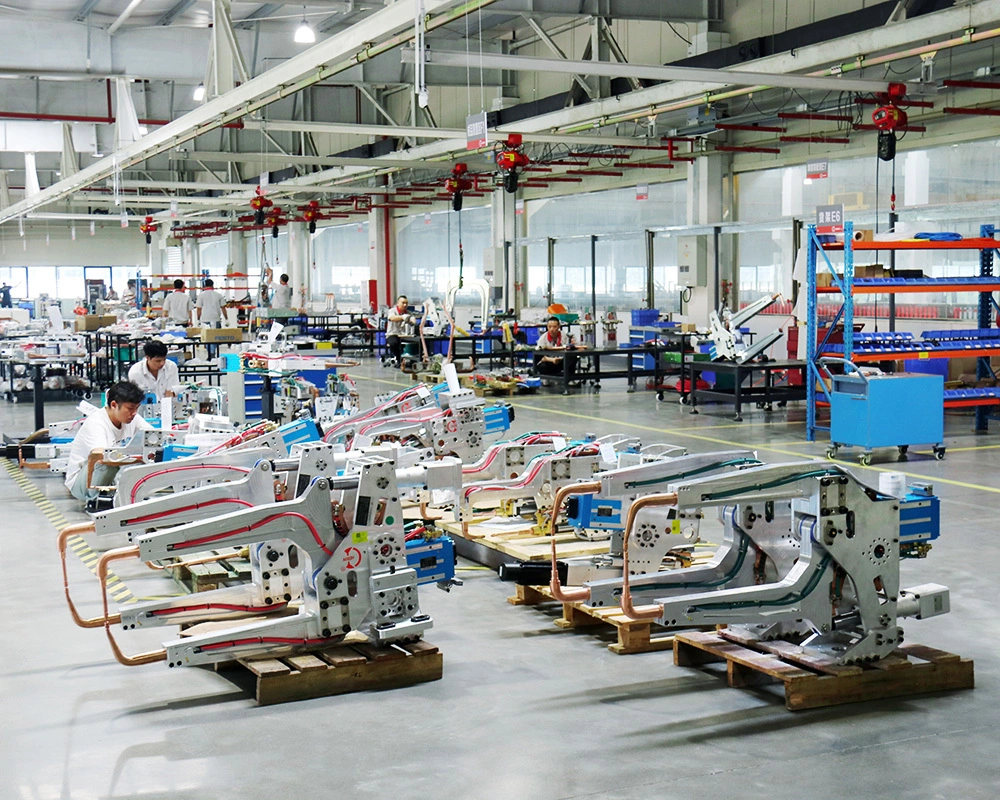
A dependable spot welding gun is essential for manufacturers that need accurate, repeatable, and efficient metal joining. In demanding production environments, welding equipment must support consistent results while handling repetitive operations and varying component requirements. Heron-Welder specializes in resistance welding technology and provides industrial welding solutions designed to help manufacturers improve productivity, process stability, and overall welding quality.
Why the Welding Gun Matters in Production
Resistance welding relies on carefully controlled electrical current, pressure, and welding time. The welding gun plays an important role in bringing these elements together at the workpiece. A well-designed system can help operators achieve stable contact, appropriate electrode pressure, and consistent weld formation.
For manufacturers, equipment selection should go beyond basic machine specifications. Factors such as workpiece geometry, material type, thickness, accessibility, production volume, and automation requirements all influence the ideal welding configuration.
Heron-Welder understands these production challenges and develops welding solutions around practical industrial requirements. Its focus on resistance welding enables manufacturers to select equipment that aligns more closely with their actual manufacturing processes.
Advantages of Heron-Welder Welding Solutions
Heron-Welder combines resistance welding expertise with an application-focused approach. Its welding equipment is designed to support manufacturers that prioritize reliable performance and repeatable production.
Key advantages include:
- Controlled resistance welding processes
- Equipment designed for repetitive industrial operations
- Flexible configurations for different applications
- Support for automated and semi-automated production
- Focus on welding consistency and process stability
- Solutions suited to diverse metal joining requirements
A properly selected spot welding gun can make repetitive welding operations more manageable by providing controlled electrode positioning and consistent application of welding force. When integrated into a suitable welding system, it can contribute to smoother production and more predictable weld quality.
Applications Across Industrial Manufacturing
Resistance welding is widely used in industries where metal components need to be joined quickly and consistently. Depending on the equipment configuration, welding systems can support applications ranging from automotive component manufacturing to general metal fabrication.
Common application areas include:
Automotive Manufacturing
Vehicle production involves extensive metal joining operations. Welding solutions can support the assembly of body components, structural parts, brackets, and other metal assemblies where repeatability is essential.
Sheet Metal Fabrication
Manufacturers working with sheet metal can benefit from controlled resistance welding for suitable overlapping joints. Proper equipment selection can help maintain consistent weld quality across repeated production cycles.
Electrical Equipment
Electrical components and enclosures often require precise joining of conductive metal parts. Appropriate resistance welding equipment can provide controlled joining without relying on additional fastening methods.
General Industrial Assembly
Machinery, hardware, appliances, and fabricated metal components can all involve repetitive joining requirements. Heron-Welder provides technology that can be adapted to different production environments.
Selecting the Right Welding Equipment
Choosing the right equipment requires a clear understanding of the application. Before investing in a welding system, manufacturers should evaluate several important factors.
Material and Thickness
Different metals and material thicknesses require different welding parameters. Understanding the workpiece characteristics helps determine appropriate current, force, electrode configuration, and welding time.
Production Requirements
High-volume manufacturing places greater demands on equipment reliability and cycle consistency. Manufacturers should select systems capable of supporting the required production schedule without compromising welding performance.
Accessibility
The shape and position of the workpiece can influence equipment configuration. Welding equipment should provide appropriate access to the intended welding locations while maintaining stable electrode contact.
Automation Level
Manufacturers should determine whether manual, semi-automatic, or automated operation best suits their production goals. Automated systems can help reduce repetitive manual handling and establish more consistent welding cycles.
Process Control
Accurate control of welding parameters is essential for repeatable results. Heron-Welder emphasizes controlled resistance welding technology to help manufacturers establish dependable production processes.
Heron-Welder: A Specialized Welding Partner
Selecting a supplier with focused technical knowledge can simplify the process of developing an effective welding operation. Heron-Welder specializes in resistance welding solutions and serves industrial applications where precision, efficiency, and consistency are important.
Rather than treating welding equipment as a one-size-fits-all purchase, Heron-Welder takes an application-oriented approach. Manufacturers can evaluate equipment according to their materials, component designs, production volumes, and automation objectives.
The company’s specialized product portfolio allows businesses to explore solutions suited to different resistance welding requirements. This focus can be especially valuable for manufacturers seeking equipment that integrates effectively into established production workflows.
Building More Efficient Welding Processes
Modern manufacturing requires more than simply joining two pieces of metal. Production teams must consider cycle efficiency, repeatability, quality control, operator requirements, and long-term equipment performance.
A suitable spot welding gun can contribute to these objectives when properly matched with the welding system and application. Consistent electrode positioning and controlled welding parameters can help reduce process variation and support dependable production.
Heron-Welder’s resistance welding solutions are developed with these manufacturing priorities in mind. By combining appropriate equipment configurations with controlled welding technology, manufacturers can build production processes that are more efficient and easier to manage.
Why Choose Heron-Welder?
Heron-Welder stands out through its specialized commitment to resistance welding technology. Its solutions are designed for manufacturers looking for dependable equipment rather than generic welding machinery.
Working with Heron-Welder can help businesses evaluate important factors such as:
- Welding application and material requirements
- Production volume and cycle expectations
- Equipment configuration
- Process control needs
- Automation objectives
- Long-term manufacturing efficiency
For businesses that require a reliable spot welding gun and supporting resistance welding technology, this application-driven approach provides a practical foundation for equipment selection.
Conclusion
The right welding equipment can have a significant influence on production consistency, efficiency, and overall manufacturing performance. A high-quality spot welding gun, when correctly matched to the application, can support reliable metal joining across demanding production environments.
Heron-Welder brings specialized resistance welding expertise to industrial manufacturers seeking practical and dependable solutions. With a focus on process control, application suitability, and production efficiency, Heron-Welder helps businesses develop welding operations built around consistent performance.
For manufacturers seeking advanced resistance welding equipment and reliable production solutions, Heron-Welder offers the technology and industry-focused approach needed to support modern manufacturing demands.
