Finding dependable metal fabrication work is essential for construction, repair, and manufacturing projects. Whether it’s structural steel for a building, custom metal parts, or urgent equipment repair, quality welding determines safety and long-term durability. Many property owners and contractors search for reliable providers such as welding services near cuyahoga falls ohio when they need skilled workmanship that meets industry standards and project deadlines.
Welding is more than joining metal pieces together. It requires technical expertise, precision, and an understanding of materials and stress points. A weak weld can lead to structural failure, costly repairs, or safety hazards. That is why professional welding services play a crucial role across industries like construction, automotive repair, oil and gas, and custom fabrication.
In today’s fast-paced industrial environment, the demand for high-quality welding continues to grow. From small residential repairs to large-scale infrastructure projects, the need for certified welders who can deliver consistent results is more important than ever.
Understanding Modern Welding Services and Their Applications
Welding services cover a broad range of metal joining and fabrication techniques designed to create strong, permanent bonds. These services are used in everything from heavy industrial structures to delicate precision components.
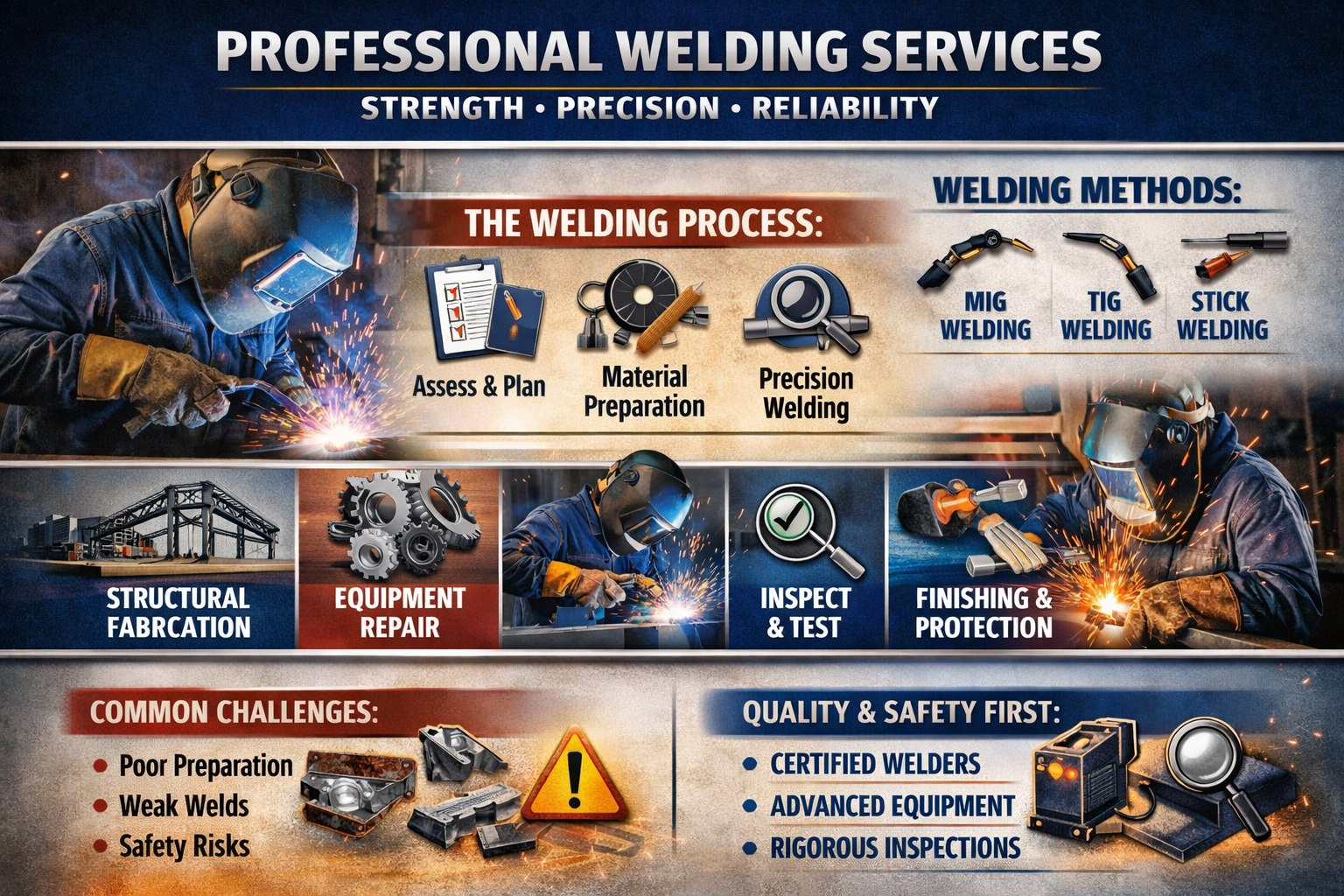
The most common welding methods include MIG (Metal Inert Gas), TIG (Tungsten Inert Gas), and Stick welding. Each method serves a different purpose depending on material type, thickness, and environmental conditions. For example, MIG welding is widely used for fast production work, while TIG welding is preferred for detailed and clean finishes on stainless steel and aluminum.
Professional welding services are typically categorized into several areas:
- Structural welding for buildings, bridges, and frameworks
- Industrial welding for machinery and equipment repair
- Custom fabrication for unique metal components
- Mobile welding for on-site repairs and installations
- Maintenance welding for restoring worn or damaged structures
Each category requires specialized skills and equipment. A certified welder understands how to evaluate stress loads, select the correct filler materials, and ensure compliance with safety standards.
In real-world applications, welding is found everywhere—from stair railings in commercial buildings to pipelines in industrial facilities. Its versatility makes it a foundation of modern engineering and construction.
Step-by-Step Process of Professional Welding Work
A professional welding project follows a structured process to ensure accuracy, strength, and durability. While the specifics may vary depending on the job, the general workflow remains consistent across most welding services.
1. Project Assessment and Planning
The first step involves understanding the project requirements. A welder evaluates the type of metal, load-bearing needs, environmental conditions, and design specifications. This stage is critical because improper planning can lead to structural weaknesses later.
For example, welding stainless steel requires different heat control compared to carbon steel. Similarly, outdoor structures may need weather-resistant techniques to prevent corrosion.
2. Material Preparation
Before welding begins, the metal surfaces must be cleaned and prepared. This includes removing rust, paint, oil, or debris that could interfere with the weld quality. Proper alignment of metal pieces is also essential to ensure accurate bonding.
In industrial settings, preparation may involve cutting, grinding, and clamping materials to achieve perfect positioning.
3. Choosing the Welding Technique
Selecting the correct welding method is a key decision. MIG welding is commonly used for speed and efficiency, while TIG welding is ideal for precision work. Stick welding is often chosen for outdoor environments due to its resistance to wind and contamination.
The welder also selects filler materials that match the base metal to ensure a strong and uniform bond.
4. Welding Execution
During the welding process, heat is applied to melt the base metal and filler material, creating a fused joint. Skilled welders control temperature, angle, and speed to ensure consistency. Poor control at this stage can result in weak or uneven welds.
Experienced professionals rely on steady hand movement and equipment calibration to achieve clean and durable results.
5. Inspection and Quality Control
After welding, the joint is inspected for cracks, porosity, or weak spots. This can involve visual inspection, ultrasonic testing, or pressure testing depending on the application.
Quality control ensures the weld meets safety standards and can withstand operational stress.
6. Finishing and Protection
The final step involves grinding, polishing, or coating the welded area. Protective finishes may be applied to prevent rust and corrosion, especially for outdoor or industrial applications.
This stage improves both the appearance and lifespan of the finished product.
Common Mistakes and Challenges in Welding Projects
Even experienced welders face challenges, but certain mistakes can significantly impact the quality and safety of a project.
One common issue is improper surface preparation. If metal is not cleaned properly, contaminants can weaken the weld and lead to early failure. Another frequent mistake is using the wrong welding technique for the material, which can cause cracks or incomplete fusion.
Inadequate heat control is also a major problem. Excess heat can warp metal, while insufficient heat can result in weak bonding. This is especially critical in precision industries like aerospace or automotive manufacturing.
Safety oversights are another concern. Welding involves high temperatures, UV exposure, and electrical risks. Without proper protective gear and ventilation, workers may face serious hazards.
Finally, skipping inspection steps can allow defects to go unnoticed, leading to long-term structural issues. Professional welding services prioritize quality checks to avoid these risks.
Practical Tips and Expert Recommendations for Better Welding Results
Achieving high-quality welding outcomes requires both skill and discipline. Professionals follow several best practices to ensure consistent results.
First, always match the welding method to the material. For example, aluminum requires different settings than steel, and using the wrong approach can compromise strength.
Second, maintain equipment regularly. Clean welding machines, replace worn tips, and calibrate settings to ensure accuracy. Faulty equipment often leads to inconsistent welds.
Third, prioritize safety at every stage. Proper gloves, helmets, and ventilation systems protect welders from burns, fumes, and eye damage. Safety is not optional in welding environments.
Fourth, consider environmental conditions. Wind, moisture, and temperature can affect weld quality, especially in outdoor projects. Shielding gas or protective enclosures may be necessary.
Finally, work with experienced professionals for complex projects. Skilled welders bring technical knowledge that helps avoid costly mistakes and ensures compliance with industry codes.
Conclusion: The Value of Skilled Welding in Modern Industries
Welding remains a foundational process in construction, manufacturing, and repair industries. Its importance lies in its ability to create strong, reliable joints that support everything from small household repairs to massive infrastructure projects.
Understanding the process, avoiding common mistakes, and applying professional techniques can significantly improve outcomes. Whether it is structural fabrication or precision metalwork, quality welding ensures safety, durability, and long-term performance.
As industries continue to evolve, the demand for skilled welding services will only increase, making expertise and precision more valuable than ever.
