Metal fabrication plants lose real money when a shear blade fails mid-run. A cracked edge, a burred sheet, or an unplanned changeover stops production and pushes deadlines back. Choosing the right shear blades from the start prevents most of these problems. This article breaks down the grades, tolerances, and selection criteria that plant engineers and purchase managers need before placing an order.
What Shear Blades Actually Do
Shear blades, also known as guillotine shear knives or machine shear blades, cut metal sheets, plates, and coils in a straight line. They sit inside guillotine shears, cut-to-length lines, press brakes, and scrap processing machines. The blade pair closes across the material with a set clearance gap, and that gap determines whether the cut comes out clean or torn.
Plants use shear blades on mild steel, stainless steel, aluminium, silicon steel, rubber, paper, and plastic. A steel service center running coil into flat sheets needs a different blade profile than a scrap yard running alligator shears on mixed ferrous material. The machine, the material, and the production volume all shape which blade type and grade fit the job.
Grades: D2, D3, H13, and H11
Tool steel grade decides how long a blade holds its edge and how it performs under repeated impact. Four grades cover almost every shearing application.
D2 works as the standard grade for cold shearing mild steel, stainless steel, and aluminium. It holds a sharp edge across high cutting volumes and resists abrasive wear well, which makes it the default choice for most CTL lines and sheet metal shops.
D3 steps up for high-wear cold shearing jobs. Plants running thicker gauge material or higher cutting frequency often move to D3 when D2 wears faster than expected.
H13 and H11 are hotwork tool steels. They handle hot shearing operations and applications where the blade takes repeated impact loads or runs at elevated temperature. Structural steel plants and heavy plate shearing lines often specify H13 or H11 because straight wear resistance matters less than toughness under shock.
Grade selection depends on three factors: the material being cut, the sheet thickness, and the machine’s duty cycle. A blade that performs well on thin aluminium sheet may wear out fast on 20mm structural plate, even within the same steel family.
Hardness and Heat Treatment
Hardness sits at the center of blade performance. Most industrial shear blades run between 58 and 62 HRC after heat treatment. Below that range, the edge dulls fast and burr formation increases. Above it, the blade turns brittle and chips under load.
Vacuum heat treatment produces the most consistent hardness across the full blade length. This process eliminates decarburization, prevents distortion during hardening, and keeps the microstructure uniform from one end of a 6000mm blade to the other. In-house heat treatment also removes the variability that comes from outsourcing this step to a third party, since furnace conditions and quench timing directly affect the final HRC value.
Mill test reports confirm hardness, chemical composition, and material grade before a blade ships. Plants running critical production lines should request these reports as standard practice, not as an afterthought.
Tolerance: Why ±0.01mm Matters
Tolerance controls how tight the clearance gap stays across the full length of the blade. CNC surface grinding holds parallelism to ±0.01 mm on precision-manufactured blades. That level of accuracy keeps the cutting gap consistent from one end of a long blade to the other, which directly affects cut quality.
Loose tolerance produces uneven clearance along the blade length. One section cuts clean while another tears the sheet or throws off excess burr. Over time, uneven wear from inconsistent clearance shortens blade life and increases scrap rate. Tight grinding tolerance is a specification worth checking before an order goes through, not something to assume.
Clearance: The Setting Most Plants Get Wrong
Clearance is the gap between the upper and lower blade edges, expressed as a percentage of material thickness. It typically runs between 5 and 15 percent, though the exact figure shifts based on both material type and thickness.
For 3mm mild steel, clearance should sit between 0.15mm and 0.45mm. Stainless steel needs a slightly wider clearance than mild steel because of its higher strength and lower ductility. Aluminium runs tighter clearance than either, since it shears more easily.
Too little clearance accelerates blade wear and produces burrs on the cut edge. Too much clearance tears the material instead of shearing it cleanly, leaving a rough, uneven edge. Getting clearance right reduces rejected sheets, extends blade life, and cuts down on machine vibration during operation.
Choosing Between Flat, Slotted, and Custom Blades
Three blade configurations cover most shearing setups.
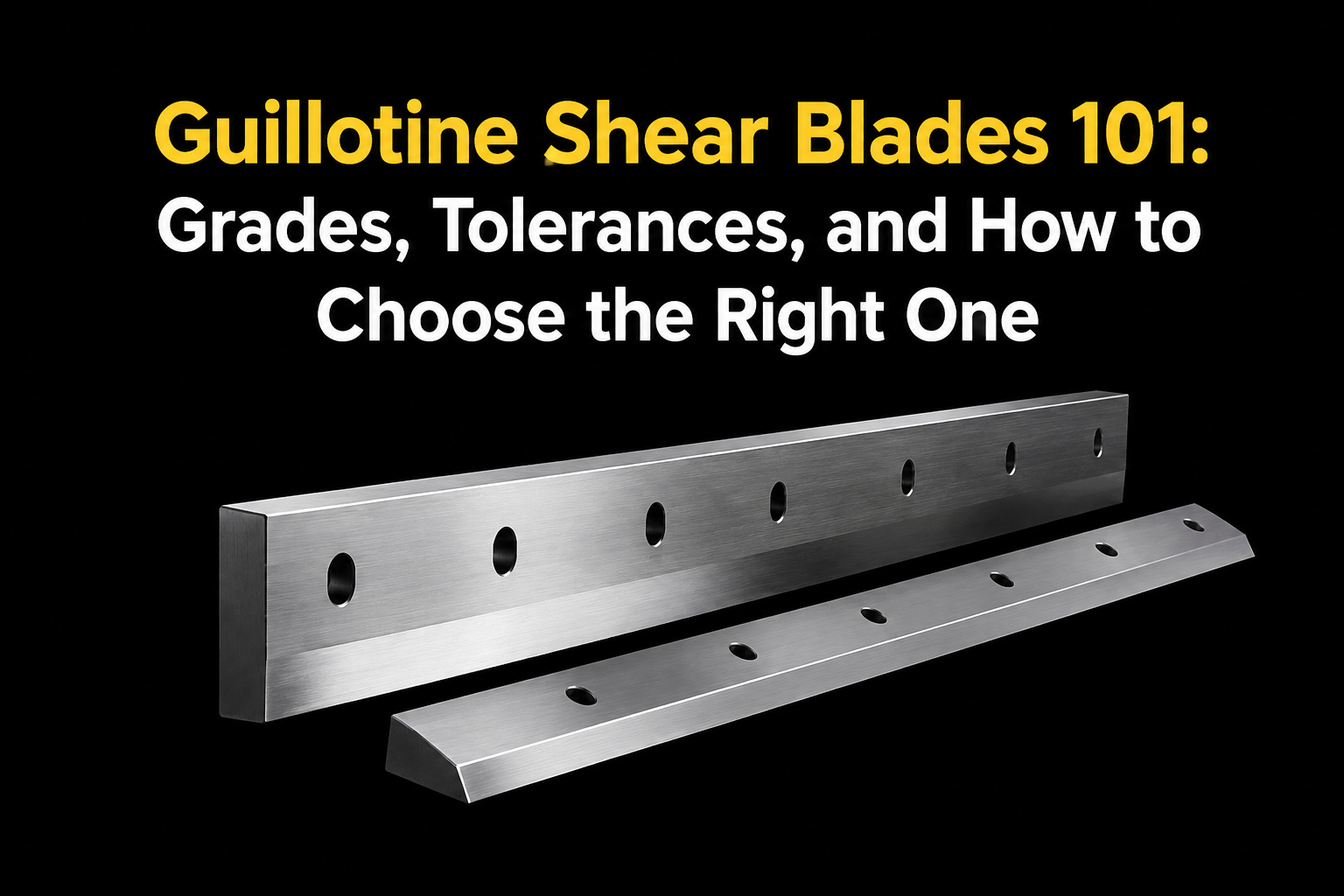
Flat blades suit sheet metal, CTL lines, blanking operations, and structural plate cutting. They come in single, two-edge, and four-edge versions, with rotatable edges that extend service life without buying a new blade body.
Slotted-hole blades use oval bolt holes that allow adjustment after regrinding, which speeds up changeovers on scrap shears, alligator machines, and recycling equipment where blades see frequent servicing.
Custom and OEM replacement blades cover legacy machines, obsolete models, and non-standard specifications. A worn or broken blade sample, or a machine model number, is often enough for a manufacturer to reverse-engineer an exact match.
Edge Count: A Cost Factor Plants Overlook
Blade edge count changes total cost of ownership more than most buyers realize. A single-edge blade offers one cutting surface. A two-edge or four-edge blade can be rotated as each edge wears down, which multiplies the working life from a single blade body.
Four-edge geometry delivers up to four times the working life compared to a single-edge blade, at a fraction of the additional manufacturing cost. For high-volume operations, this rotation strategy reduces the frequency of full blade replacement and lowers cost per tonne cut, which matters more to a purchase manager than the upfront unit price.
Regrinding vs. Replacement
Worn blades don’t always need replacement. A regrinding service restores dimensional tolerance and typically costs 40 to 60 percent less than a new blade. Turnaround for this service generally runs 5 to 7 working days, which keeps downtime manageable for plants that plan blade rotation.
Signs that a blade needs regrinding include rough cut edges, rising burr formation, higher cutting force, visible chipping, and a drop in dimensional accuracy. Catching these signs early prevents further edge damage and keeps regrinding cost-effective rather than requiring a full replacement.
Final Selection Checklist
Before placing an order, plants should confirm seven specifications: blade length, width, thickness, bevel angle, required clearance, target hardness, and edge count. Maxwell Slitter Industries manufactures shear blades to these specifications in D2, D3, H13, and H11 grades, with CNC grinding held to ±0.01mm tolerance and vacuum heat treatment performed in-house.
Matching grade to material, confirming tolerance specifications, and setting the correct clearance for the job prevents the majority of shearing problems plants encounter. A blade specified correctly the first time reduces downtime, cuts scrap rate, and lowers the long-term cost per tonne cut. Maxwell Slitter Industries also offers custom and OEM replacement blades up to 6000mm in a single piece for machines running legacy or non-standard specifications.
