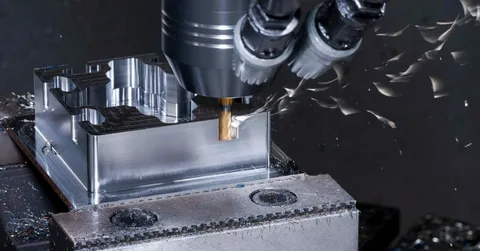
CNC (Computer Numerical Control) machining has transformed modern manufacturing by enabling highly precise, repeatable, and efficient production of custom parts. From aerospace components to medical devices, the applications of cnc machining continue to expand across industries that demand accuracy, speed, and flexibility. This technology allows manufacturers to turn digital designs into physical parts with minimal error, making it essential for custom production needs.
Precision Engineering in Custom Part Production
CNC machining plays a crucial role in precision engineering, where even the smallest deviation can affect performance. In custom part production, CNC machines ensure tight tolerances and consistent quality across every unit. This makes it ideal for industries where exact measurements are non-negotiable, such as robotics, defense, and scientific equipment manufacturing.
Another major advantage is the ability to produce complex geometries that would be difficult or impossible using traditional machining methods. Engineers rely on CNC systems to bring intricate digital designs to life with high accuracy, reducing the need for manual intervention and minimizing human error.
Key Points:
- Achieves extremely tight tolerances for custom parts
- Reduces human error in manufacturing processes
- Enables production of complex and intricate geometries
- Improves consistency across multiple production runs
- Supports rapid prototyping and design validation
- Enhances efficiency in precision-driven industries
Aerospace and Automotive Custom Components
One of the most important applications of cnc machining is in the aerospace and automotive sectors, where performance and safety depend on precision-engineered parts. CNC machines are used to produce engine components, brackets, housings, and structural parts that must withstand extreme conditions.
In automotive manufacturing, CNC machining allows for the creation of custom prototypes and performance parts tailored to specific vehicle requirements. Similarly, aerospace engineers depend on CNC technology to manufacture lightweight yet strong components that meet strict industry standards.
Key Points:
- Produces high-strength aerospace structural components
- Manufactures automotive engine and transmission parts
- Supports lightweight design for fuel efficiency
- Enables rapid prototyping for vehicle innovation
- Ensures compliance with strict safety standards
- Reduces production time for custom automotive parts
Medical Device Custom Manufacturing
The medical industry heavily relies on CNC machining for producing custom surgical tools, implants, and prosthetics. Precision is critical in this field, and CNC technology ensures that every component meets exact medical specifications.
Additionally, patient-specific implants and devices can be manufactured based on digital scans, improving comfort and functionality. This level of customization has significantly improved healthcare outcomes and is a key reason why the applications of cnc machining continue to grow in medical technology.
Key Points:
- Produces custom orthopedic implants and prosthetics
- Manufactures surgical instruments with high precision
- Allows patient-specific medical device customization
- Ensures biocompatibility and safety standards
- Supports rapid production for emergency medical needs
- Improves accuracy in minimally invasive surgical tools
Electronics and Prototyping Applications
CNC machining is widely used in the electronics industry for producing enclosures, heat sinks, circuit housings, and connectors. As electronic devices become smaller and more complex, CNC technology provides the precision required to create compact and efficient components.
It is also a vital tool for prototyping new electronic products. Engineers use CNC machining to quickly test design concepts before moving into mass production. This reduces development costs and speeds up innovation cycles in industries such as consumer electronics, telecommunications, and computing.
Key Points:
- Produces precise electronic device housings and enclosures
- Manufactures heat sinks for thermal management
- Supports rapid prototyping of electronic components
- Improves product development speed and efficiency
- Enables miniaturization of complex electronic parts
- Reduces cost of early-stage product testing
Industrial Equipment and Small-Batch Production
Industrial machinery often requires durable and highly customized parts, which makes CNC machining an ideal solution. From gears and shafts to machine fixtures, CNC systems ensure reliable performance in demanding industrial environments.
Small-batch production is another significant advantage of CNC machining. Unlike mass production methods, CNC allows manufacturers to produce limited quantities of customized parts without high setup costs. This flexibility is one of the key applications of cnc machining in modern manufacturing.
Key Points:
- Produces durable components for heavy machinery
- Supports custom industrial tooling and fixtures
- Enables cost-effective small-batch manufacturing
- Reduces setup time for specialized production runs
- Ensures consistent quality in industrial parts
- Improves maintenance and replacement part availability
Conclusion
CNC machining has become a cornerstone of modern manufacturing due to its versatility, precision, and efficiency. The wide-ranging applications of cnc machining in industries such as aerospace, automotive, medical, electronics, and industrial production demonstrate its importance in custom part manufacturing. As technology continues to advance, CNC machining will play an even greater role in enabling innovation, reducing production costs, and improving product quality across global industries.
