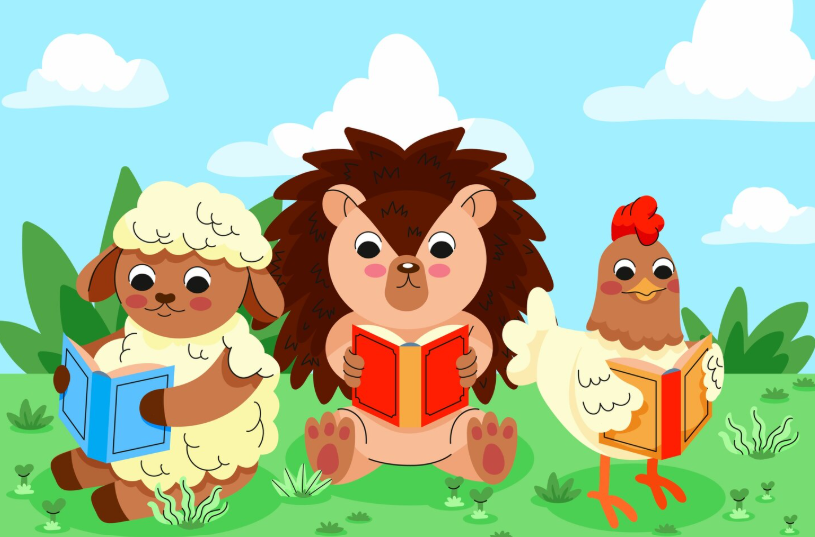
A fox who cannot stop asking questions. A tiny rabbit who is afraid to leave home. A clever crow trying to solve a simple problem. These characters may be animals, but their feelings often look surprisingly familiar.
That is one reason I have always loved animal stories for kids.
A good animal story can make a child laugh, wonder, and think without feeling like a lesson. The story comes first. The learning often follows naturally.
A little library can make this experience even more special. It does not have to be a large room filled with hundreds of books. A small shelf, a reading corner, or even a carefully chosen collection of digital stories can become a little library where children discover new characters and ideas.
For parents, teachers, and young readers, animal stories offer an easy way to begin that journey.
Why Do Children Love Animal Stories?
There is something naturally appealing about animals in children’s books.
Children already have questions about animals. Why does an owl stay awake at night? Where does a squirrel hide its food? Can a turtle really be patient enough to win a race?
Stories take those questions and turn them into adventures.
When animals become story characters, children can also explore feelings in a comfortable way. A nervous little mouse can represent fear. A lonely puppy can show the need for friendship. A brave deer can help children understand courage.
The child is not being told, “This is how you should behave.”
Instead, the child watches the character make choices and discovers the meaning through the story.
That makes reading feel like an experience rather than a lesson.
Animal Stories Can Teach Without Feeling Like Lessons
Some of the best children’s stories leave a small thought in a child’s mind.
Imagine a story about a young squirrel who takes more food than she needs. At first, she feels proud of her large collection. Later, winter arrives, and she discovers that another animal has nothing to eat.
The story can lead to a conversation about sharing.
Or imagine a young turtle who keeps comparing himself with faster animals. He becomes frustrated because he cannot run like a rabbit or climb like a monkey. Eventually, he discovers that being slow does not mean being incapable.
A story like this can encourage children to think about patience and self-confidence.
Animal stories for kids can introduce ideas such as:
- Friendship and kindness
- Sharing and cooperation
- Courage
- Patience
- Honesty
- Responsibility
- Respect for nature
- Problem-solving
- Understanding other people’s feelings
The strongest stories usually avoid making these ideas too obvious. Children remember characters and adventures more easily than instructions.
A Little Library Can Become a Child’s Special Place
When I think about a little library, I do not picture the number of books first.
I picture the feeling.
Perhaps there is a small chair beside a bookshelf. A child picks a book with a colorful fox on the cover. They sit down and begin reading. After a few pages, they stop to ask a parent what a particular word means.
That simple moment is part of learning.
A little library can be created almost anywhere.
It could be:
- A small bookshelf in a child’s bedroom
- A reading basket in the living room
- A classroom reading corner
- A shelf at a community center
- A collection of digital children’s books
- A shared family book collection
The size does not matter as much as the invitation to read.
When books are easy to reach, children are more likely to pick them up.
Choosing Animal Stories for Different Ages
Not every animal story works equally well for every child.
A three-year-old may enjoy a short story with repetition, simple characters, and bright pictures. An older child may want a longer adventure with a mystery or a problem to solve.
Ages 3–5
Young children often enjoy stories with:
- Simple language
- Repeated words and phrases
- Friendly animal characters
- Short adventures
- Clear emotions
- Colorful illustrations
A story about a little bear searching for his missing red ball may be enough to keep a young reader interested.
At this age, reading aloud is especially valuable. Children can listen to your voice, look at pictures, repeat phrases, and ask questions.
Ages 6–8
Children in this age group are often ready for more detailed stories.
They may enjoy a clever fox solving a mystery, a group of animals going on an adventure, or a young penguin trying something new.
This is also a useful age for introducing different genres through animal characters:
- Mystery
- Fantasy
- Adventure
- Funny stories
- Historical fiction
- Science fiction
- Gentle scary stories
The goal is not simply to finish the book. It is to help children discover what kind of stories they enjoy.
Ages 9–12
Older children can handle deeper themes and more complex plots.
An animal story might involve a difficult decision, a friendship that changes, or a journey where the character must learn from mistakes.
At this stage, ask questions after reading:
“What would you have done?”
“Was the character’s decision fair?”
“Why do you think the animal was afraid?”
“Would you have made the same choice?”
There is no need for every answer to be correct. The conversation itself helps children think more deeply.
Reading Animal Stories Together
One of my favorite things about children’s books is that reading does not have to happen alone.
A parent and child can share a story before bedtime. A teacher can read a chapter to the class. Older siblings can read to younger children.
Even ten or fifteen minutes can create a meaningful routine.
Try changing your voice for different characters. Pause before an exciting moment. Ask the child what they think will happen next.
If the main character is a rabbit hiding behind a tree, stop and ask:
“Why do you think she is hiding?”
That one question can turn passive listening into active thinking.
The child begins making predictions, noticing clues, and connecting the story with their own experiences.
Let Children Choose Some of Their Own Books
Adults naturally want to choose books they believe children should read.
That can be helpful, but children also need freedom.
If a child wants to read another funny animal story instead of the serious book you selected, that does not mean the reading time has failed.
The child is still reading.
A little library works best when children feel that some of the books belong to their world.
You can create different sections, such as:
Funny Animals
Animal Adventures
Bedtime Stories
Mystery Animals
Stories About Friendship
Nature and Wildlife
This simple organization can make choosing a book feel like a small adventure.
Ask Questions That Keep the Story Alive
After reading an animal story, you do not need to give a quiz.
Simple questions are often better.
Try asking:
- Which character did you like most?
- What was the funniest part?
- Was the animal right to make that choice?
- What would you change about the ending?
- Which character would you want as a friend?
- What do you think happened after the story ended?
These questions give children room to express their own ideas.
Sometimes their answers can be wonderfully unexpected.
A child may love the “bad” character because they think the character was lonely. Another child may focus on a tiny detail that an adult completely missed.
That is part of the magic of reading together.
Animal Stories Can Encourage Creativity
A good story does not always need to end when the last page is finished.
Ask a child to create another adventure for the same animal.
Perhaps the rabbit from the story finds a mysterious key. Where does it lead?
Maybe the clever crow discovers a strange object in the garden. What does it do?
Maybe the shy fox meets another animal who needs help.
Children can draw pictures, write a few sentences, act out scenes, or simply tell the story aloud.
This turns reading into creative play.
For younger children, drawing their favorite animal may be enough. Older children might enjoy writing a new ending or creating their own group of characters.
Build a Small Animal-Themed Reading Collection
If you are starting a little library, you do not need to buy dozens of books at once.
Start small.
Choose a few stories that are different from one another.
For example:
- One funny animal story
- One friendship story
- One adventure
- One nature-focused story
- One bedtime story
- One mystery
- One story with a gentle life lesson
Over time, watch what the child chooses.
If they repeatedly pick mystery stories, add more mysteries.
If they love stories about bears, look for different kinds of bear characters.
Their choices can tell you a lot about their interests.
Digital Stories Can Also Be Part of a Little Library
A little library does not have to exist only on a physical shelf.
Digital reading can give families access to stories when they are traveling, waiting for an appointment, or simply looking for something new to read at home.
The same basic rule still applies: choose age-appropriate stories, keep reading comfortable, and make room for discussion.
A digital collection can also be organized by age or theme, making it easier for children to find something suitable.
The real purpose is not the format.
It is giving children regular opportunities to meet stories.
Why Animal Characters Stay With Us
Think back to stories you loved as a child.
You may not remember every sentence.
But you may remember the little animal who made you laugh, the character who was brave when everyone else was afraid, or the friend who helped someone in trouble.
Characters can stay in our memories for years.
Animal stories are especially good at this because they combine familiar creatures with imaginative situations.
A fox can talk.
A rabbit can solve a mystery.
A bear can become someone’s best friend.
A tiny bird can make an enormous difference.
The possibilities are almost endless.
Making Reading a Happy Habit
Children do not need perfect reading routines.
They need positive experiences with books.
If bedtime reading becomes a stressful demand every night, a child may begin to connect books with pressure.
Instead, create small moments that feel enjoyable.
Let a child choose the story sometimes.
Read a funny story when everyone needs a laugh.
Read a gentle story before sleep.
Visit a library and let the child browse.
Keep a few books within easy reach.
Most of all, show that reading is something adults enjoy too.
Children notice when we read for pleasure.
A Little Library Can Grow With a Child
One of the nicest things about a little library is that it can change.
A collection that begins with picture books about puppies and kittens may eventually include chapter books, fantasy adventures, mysteries, poetry, nature books, and stories from different cultures.
The shelf grows because the reader grows.
That is why I see animal stories for kids as more than simple entertainment. They can be an early doorway into a much larger reading life.
A child meets a curious fox today.
Tomorrow, that same child may want to read about oceans, space, history, or another country.
One story can lead to another.
One question can lead to a new book.
And one small reading corner can become the beginning of a lifelong relationship with books.
Final Thoughts
Animal stories have a special place in children’s reading because they make big ideas feel close and understandable.
Through a rabbit, a child can explore fear.
Through a lion, courage.
Through a group of forest animals, friendship and cooperation.
Through a curious bird, the joy of asking questions.
A little library gives these stories a home.
It does not need to be expensive or impressive. A few carefully chosen books, a comfortable place to sit, and an adult willing to read together can be enough.
As a book lover, that is what I find most exciting about children’s reading. We are not simply giving children stories. We are giving them characters to remember, questions to ask, ideas to explore, and quiet moments where their imagination can take the lead.
Sometimes, all of that begins with a small book about a very curious animal.
