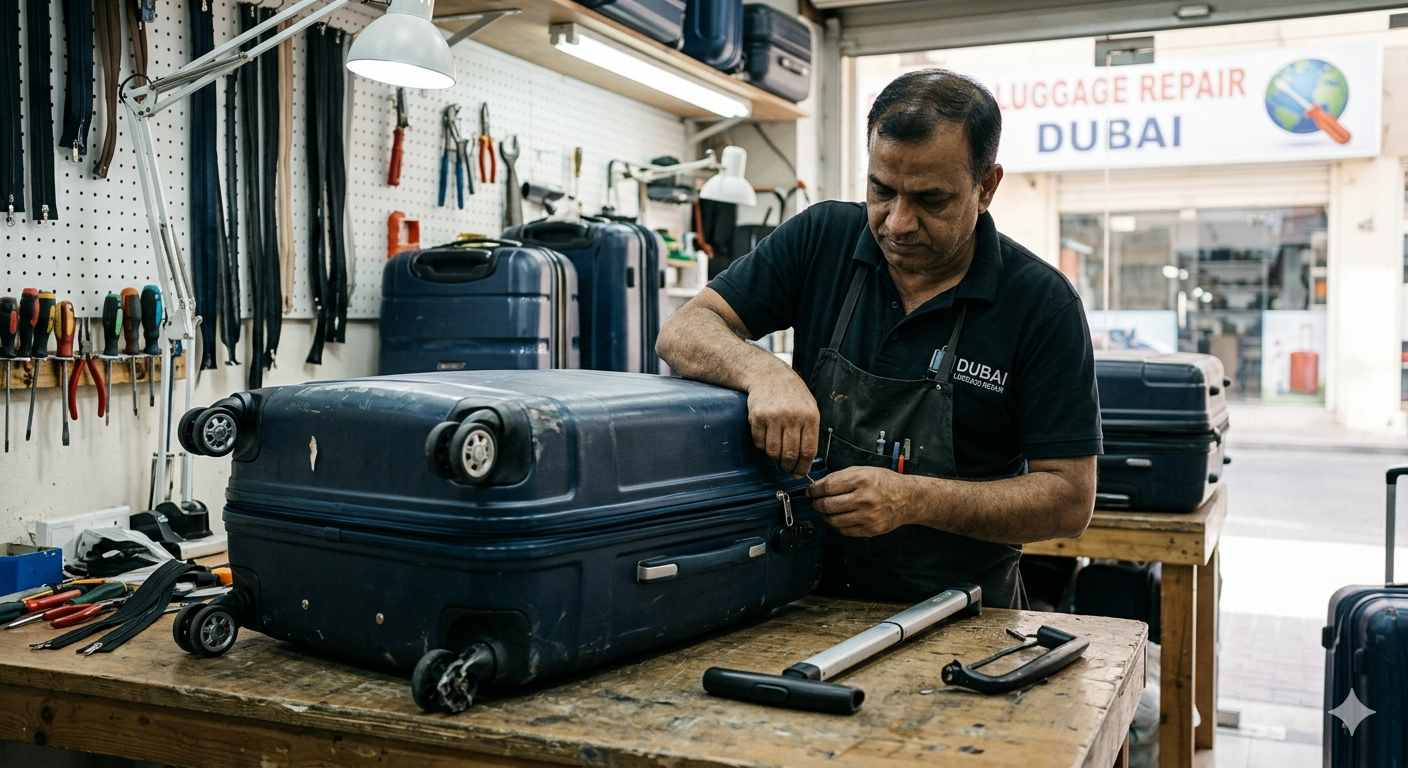
A suitcase rarely becomes unusable all at once. More often, its condition changes gradually. A wheel begins making noise, a handle becomes loose, a zipper starts catching, or a seam begins to separate. Because these problems may appear one at a time, travelers often continue using the luggage until a minor defect becomes a major inconvenience.
That does not always mean the suitcase needs to be replaced.
For travelers searching for luggage repair Dubai, professional repair can provide an opportunity to assess the condition of existing luggage and determine whether individual components can be restored. The smarter approach is to look at the suitcase as a complete travel tool and understand what is actually preventing it from performing properly.
Your Suitcase Has More Than One Life
Luggage is exposed to conditions that ordinary household possessions rarely experience.
It is moved across different surfaces, lifted repeatedly, packed beyond its comfortable capacity, stored for long periods, and handled during transportation. Over time, these experiences can affect different components at different rates.
The shell might remain strong while the wheels deteriorate. The interior could still be excellent while the handle mechanism becomes unreliable.
This means the age of a suitcase alone does not determine whether it should be replaced.
Its current condition matters more.
Start With Function, Not Appearance
A heavily scratched suitcase can still be perfectly dependable.
On the other hand, a case that looks almost new may contain a serious problem around a wheel mount or handle attachment.
When evaluating luggage, focus first on how it performs.
Roll it across the floor. Open and close the compartments. Pull the handle upward. Examine the seams and corners. Test the closures.
Cosmetic marks can usually be separated from defects that affect safety, movement, or the ability to keep belongings secured.
This simple distinction can prevent travelers from replacing luggage unnecessarily.
Why Wheels Often Reveal the First Signs of Wear
Wheels experience continuous friction and impact.
Every trip exposes them to surfaces that vary from smooth floors to rough pavement. Heavy luggage places additional pressure on the wheel assemblies.
Early warning signs can include uneven rolling, unusual sounds, wobbling, resistance when changing direction, or visible looseness.
Ignoring these symptoms can make the suitcase increasingly difficult to control.
A luggage repair professional can inspect the wheel assembly and determine whether the issue is limited to the wheel or extends to the surrounding mounting structure.
The Handle Should Feel Stable, Not Merely Functional
A retractable handle can still move while already showing signs of failure.
If it shakes excessively, refuses to lock, becomes difficult to extend, or slips back down during use, it deserves attention.
The handle is particularly important because travelers depend on it to control the suitcase. A weakness in the mechanism can become more noticeable once the case is heavily packed.
Repair or replacement decisions should take into account both the handle and the points where it connects to the luggage body.
Zipper Problems Are Often Smaller Than They Look
A suitcase zipper can develop several types of faults.
The slider may catch. The pull tab may break. The zipper may separate after closing. The surrounding fabric may become damaged.
These problems should not automatically be treated as a reason to replace the complete suitcase.
Sometimes a small component is responsible for the malfunction. A repair specialist can determine whether the existing zipper system can be restored or whether a larger replacement is justified.
The advantage of diagnosis is that it avoids paying for work that the suitcase does not actually need.
Hard-Shell Luggage Requires a Different Evaluation
A crack in a hard-shell suitcase deserves attention, but its location and severity matter.
A small surface imperfection may have little effect on usability. Damage around a corner, wheel housing, handle mount, or closure area can be more consequential because these sections experience additional stress.
Before attempting an improvised repair, consider whether the affected section can withstand another journey.
A professional assessment can help distinguish cosmetic damage from structural concerns.
Soft Luggage Can Hide Wear
Fabric luggage presents a different challenge because damage may develop gradually.
A small tear can expand when the suitcase is packed tightly. Loose stitching may become more pronounced around handles or pockets. Repeated loading can weaken sections that initially appear intact.
Repairing fabric luggage may involve restoring seams, reinforcing affected areas, or addressing damaged attachments.
The surrounding material should be considered as part of the repair rather than focusing exclusively on the visible tear.
Dubai Travelers Have Different Luggage Demands
Not everyone uses luggage in the same way.
Frequent business travelers may rely on compact cases that are repeatedly transported. Families may use larger suitcases that carry heavier loads. International travelers can expose their luggage to long journeys and multiple handling stages.
Because usage varies, the same repair may have different importance for different travelers.
Someone who travels every week needs a repair that can withstand repeated use. Someone who takes occasional holidays may have different priorities.
The repair decision should reflect the expected workload of the suitcase.
Repair Before Travel, Not During Travel
The worst moment to discover luggage damage is when you are already traveling.
A wheel can become unusable after a long journey. A damaged zipper may fail when the suitcase is packed. A weak handle can become difficult to operate when the case is heavy.
Testing luggage before departure creates an opportunity to identify these problems.
Give the suitcase a realistic trial. Put some weight inside, move it across different surfaces, and operate all major components.
If anything feels unreliable, consider having it inspected before the trip.
Choosing a Luggage Repair Service in Dubai
Searching for luggage repair Dubai is only the beginning.
A suitable repair provider should have experience with luggage rather than treating it exactly like ordinary household hardware. Different suitcase brands and designs use different wheels, handles, closures, materials, and attachment systems.
Before approving work, explain the problem clearly and, if possible, provide photographs.
Ask whether the damaged component can be repaired, whether a replacement is necessary, and whether the proposed part is suitable for the suitcase.
A clear explanation can help you decide whether the repair is worthwhile.
Ask What Happens After the Repair
A good repair should restore practical function.
For a wheel, that means stable movement. For a handle, it means controlled extension and secure positioning. For a zipper, it means dependable opening and closing.
Do not judge the work solely by appearance.
Test the repaired luggage before your next major journey. Load it moderately and repeat the movements it will experience during travel.
This is particularly important when the repaired component carries weight or receives repeated mechanical stress.
Repair or Replace? Make the Decision Objectively
There are cases where replacement is the sensible answer.
If the suitcase has severe structural damage, numerous failing components, or repair requirements that approach the price of suitable new luggage, restoration may no longer be economical.
However, a case with a strong body and one damaged component deserves a different evaluation.
Consider:
- The condition of the main structure
- The number of failed components
- The expected cost of repair
- How frequently the suitcase will be used
- Whether compatible replacement parts are available
- Whether you already find the suitcase comfortable and practical
This approach produces a more rational decision than simply replacing luggage at the first sign of trouble.
Keeping Luggage in Better Condition
Repair is only one part of extending luggage life.
Avoid overloading the case beyond its practical capacity. Store it in a dry location. Do not use the telescopic handle to lift a heavy suitcase when the body itself should be lifted. Keep wheel areas reasonably clean and avoid dragging luggage unnecessarily over surfaces that could damage the wheels.
Small habits can reduce stress on the components that usually receive the most use.
Why Repair Can Be the More Convenient Choice
Buying new luggage takes time.
You have to compare products, select a suitable size, check airline requirements, evaluate materials, and become familiar with the new design.
A repaired suitcase, by contrast, already fits into your travel routine.
If the repair restores the failed component effectively, you can continue using luggage whose capacity and layout you already understand.
For many travelers, that familiarity has genuine practical value.
Final Thoughts
Luggage is built to accompany people through repeated journeys, but no suitcase remains untouched forever. Wear develops gradually, and individual components can fail long before the main structure becomes unusable.
When a suitcase begins showing problems, luggage repair Dubai services can offer an alternative to immediate replacement. The right decision starts with understanding the damage, considering how the luggage is used, and determining whether the affected component can be restored reliably.
