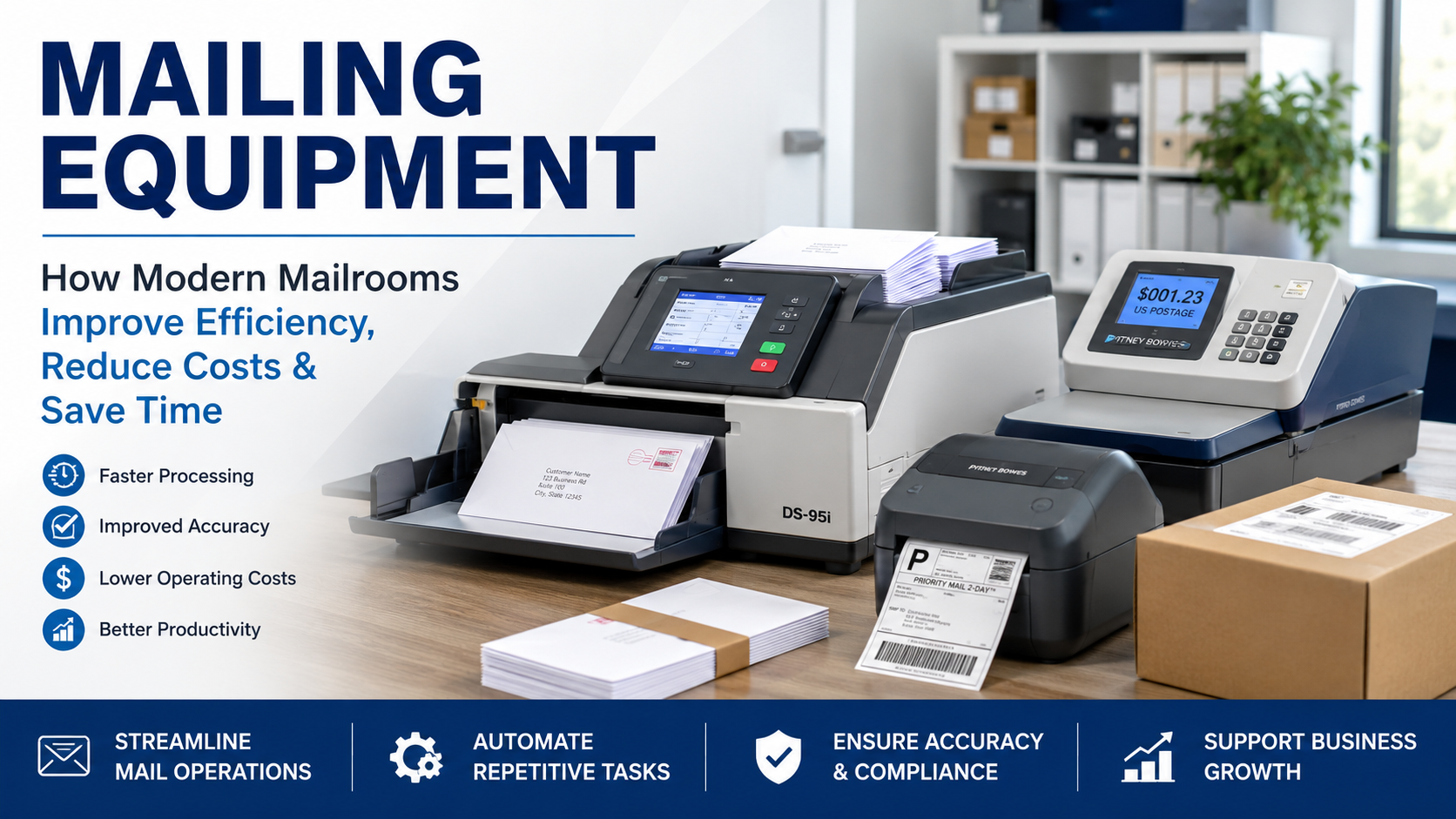
Businesses still rely heavily on physical mail for invoices, contracts, legal notices, checks, marketing campaigns, and customer communications. However, handling large volumes of mail manually can slow operations, increase labor costs, and create avoidable errors. This is where modern mailing equipment becomes essential for organizations that want faster workflows and more reliable mail processing.
Companies managing recurring shipments or business correspondence often explore solutions such as postage meters, folder inserters, address printers, and mail sorters to streamline daily operations. Organizations searching for mailing equipment near romulus michigan frequently do so because they need practical ways to improve productivity while reducing mailing delays and operational inefficiencies.
For small businesses, schools, healthcare facilities, warehouses, and enterprise offices, investing in the right equipment can dramatically improve mail accuracy and turnaround times. Understanding how these systems work helps businesses choose solutions that fit their workflow instead of overspending on unnecessary features.
Understanding Mailing Equipment and Its Role in Business Operations
Mailing equipment refers to machines and systems designed to automate mail preparation, postage application, sorting, sealing, labeling, and document insertion. Instead of relying on manual handling, businesses use specialized equipment to process high mail volumes more efficiently.
The most common types of mailing equipment include:
- Postage meters
- Folder inserters
- Address printers
- Letter openers
- Mail sorters
- Envelope sealers
- Tabbers
- Shipping label printers
Each serves a specific purpose within a mailroom or office environment.
For example, a medical billing office sending thousands of statements each month may use folder inserters to automatically fold documents and place them into envelopes. Meanwhile, an e-commerce company may depend on shipping label printers and address verification systems to improve package accuracy.
Modern mailing systems also help businesses maintain consistency. Manual mailing processes often lead to postage mistakes, missing documents, and delivery delays. Automated systems minimize these issues while saving employee time.
Another important advantage is scalability. As companies grow, manual mailing becomes increasingly difficult to manage. Equipment allows organizations to process larger mail volumes without proportionally increasing labor costs.
How Mailing Equipment Improves Workflow Efficiency
Businesses that process outgoing mail daily often notice operational bottlenecks before they realize the source of the problem. Employees spend excessive time folding papers, stuffing envelopes, applying postage, or organizing shipments manually.
Mailing equipment addresses these inefficiencies directly.
Faster Mail Processing
Automated systems complete repetitive tasks significantly faster than manual labor. A folder inserter can process thousands of documents per hour, reducing hours of repetitive work into minutes.
This speed matters for industries with time-sensitive communication, including:
- Financial services
- Insurance companies
- Government offices
- Educational institutions
- Healthcare providers
Faster processing also improves customer satisfaction by ensuring invoices, notices, and correspondence arrive on schedule.
Reduced Human Error
Manual mailing tasks create opportunities for mistakes. Documents can be inserted into the wrong envelopes, addresses may contain errors, or insufficient postage may delay deliveries.
Advanced mailing systems reduce these risks through automation and verification features. Some systems even scan barcodes to ensure each recipient receives the correct documents.
Better Cost Control
Businesses often underestimate mailing expenses. Small inefficiencies accumulate over time through wasted postage, duplicate mailings, and labor costs.
Mailing equipment helps organizations:
- Track postage spending
- Eliminate unnecessary postage use
- Reduce paper waste
- Lower overtime expenses
- Improve employee productivity
Over time, these savings can offset equipment investment costs.
Step-by-Step Guide to Choosing the Right Mailing Equipment
Selecting the right mailing equipment depends on business size, mail volume, and operational needs. Buying systems without understanding workflow requirements can lead to unnecessary expenses or underperforming solutions.
Step 1: Analyze Mail Volume
Start by evaluating how much outgoing mail the business handles weekly or monthly.
Questions to consider include:
- How many letters are sent daily?
- Are packages included?
- Is mail seasonal or consistent year-round?
- Does the business send invoices, advertisements, or compliance notices?
A small office mailing 100 envelopes weekly needs different equipment than a warehouse processing thousands of shipments daily.
Step 2: Identify Workflow Bottlenecks
Determine which tasks consume the most employee time.
Common bottlenecks include:
- Folding documents
- Stuffing envelopes
- Applying postage
- Sorting outgoing mail
- Printing labels
Once businesses identify inefficiencies, they can prioritize equipment that addresses those specific challenges.
Step 3: Consider Integration Capabilities
Modern mailing systems often integrate with software platforms for tracking, accounting, and customer management.
For example, shipping systems may integrate with inventory management software to automatically generate shipping labels and tracking information.
Integration reduces duplicate data entry and improves operational visibility.
Step 4: Evaluate Maintenance and Support
Reliable support matters because mailing disruptions can delay critical communications.
Before selecting equipment, businesses should review:
- Maintenance availability
- Equipment warranty terms
- Technical support responsiveness
- Replacement part accessibility
- Training options
Reliable service reduces downtime and keeps operations running smoothly.
Common Mailing Equipment Challenges Businesses Face
Even well-equipped mailrooms encounter operational issues. Understanding common challenges helps businesses avoid costly mistakes.
Choosing Equipment That Is Too Advanced
Some organizations invest in oversized systems with features they rarely use. This increases costs without delivering meaningful efficiency improvements.
Businesses should focus on current operational needs while allowing moderate room for future growth.
Ignoring Employee Training
Advanced mailing systems still require proper operation. Poor training often results in equipment misuse, processing errors, and unnecessary service calls.
Employees should understand:
- Basic troubleshooting
- Routine maintenance
- Proper loading procedures
- Software operation
- Security practices
Training improves efficiency while extending equipment lifespan.
Overlooking Postal Compliance
Postal regulations change periodically. Incorrect postage settings or addressing standards may cause delivery delays or returned mail.
Modern systems often include postal rate updates and address verification tools to maintain compliance.
Failing to Monitor Equipment Performance
Businesses sometimes install mailing equipment and assume operations will automatically improve forever.
However, regular performance reviews help identify:
- Workflow inefficiencies
- Equipment underutilization
- Maintenance issues
- Rising postage expenses
Ongoing monitoring ensures systems continue delivering value.
Practical Tips for Maximizing Mailing Equipment Performance
Businesses achieve the best results when mailing equipment becomes part of a broader operational strategy rather than a standalone purchase.
Standardize Mail Preparation Processes
Creating standardized procedures reduces confusion and improves consistency.
For example:
- Use uniform document formats
- Organize outgoing mail by department
- Establish scheduled mailing times
- Maintain updated address databases
Consistency helps automated systems perform more efficiently.
Schedule Preventive Maintenance
Routine maintenance prevents breakdowns and extends equipment life.
Preventive maintenance often includes:
- Cleaning rollers
- Updating software
- Replacing worn parts
- Inspecting feeding systems
- Checking postage calibration
Businesses that ignore maintenance often experience avoidable downtime during peak mailing periods.
Use Data to Improve Operations
Many modern mailing systems generate operational reports. These reports help organizations identify trends and optimize workflows.
Useful metrics include:
- Postage spending
- Mail processing time
- Error rates
- Equipment utilization
- Shipping volume trends
Data-driven decisions help businesses control costs more effectively.
Match Equipment to Business Growth
Mailing needs evolve as organizations expand. Equipment should support operational growth without becoming obsolete too quickly.
Businesses planning future expansion may benefit from modular systems that allow additional features later instead of replacing entire machines.
Conclusion
Mailing equipment plays a critical role in improving efficiency, reducing costs, and minimizing errors in modern business operations. From postage meters to automated inserters and shipping systems, the right tools can transform slow manual workflows into streamlined processes that support long-term growth.
Organizations that carefully evaluate their mailing volume, workflow challenges, and operational goals are more likely to choose systems that deliver measurable value. With proper maintenance, employee training, and process optimization, mailing equipment becomes a long-term investment that improves productivity across the entire organization.
