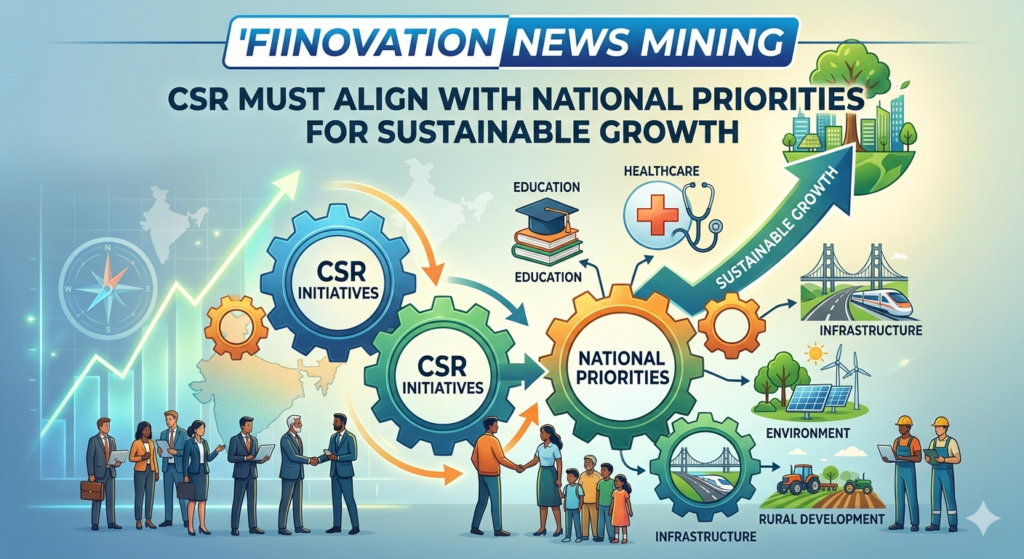
India’s mining sector plays a crucial role in supporting industrial growth, infrastructure development, and economic expansion. However, the industry also faces increasing pressure to address environmental challenges, social inequalities, and community welfare concerns. Experts now believe that Corporate Social Responsibility (CSR) initiatives in the mining sector must go beyond traditional philanthropy and align closely with India’s national sustainability priorities.
As sustainability becomes a global priority, mining companies are expected to adopt responsible business practices that contribute to long-term development. Industry leaders, policy experts, and development organizations are highlighting the need for strategic mining CSR programs that focus on environmental protection, livelihood generation, healthcare, education, and community empowerment.
The Growing Importance of Mining CSR in India
The mining industry contributes significantly to India’s GDP and provides employment opportunities to millions of people. At the same time, mining operations often impact local ecosystems, tribal populations, water resources, and biodiversity. This has increased the need for effective CSR programs that balance economic growth with social and environmental responsibility.
Mining CSR is no longer limited to charitable donations or short-term welfare projects. Today, companies are expected to create measurable and sustainable impact through well-planned CSR initiatives. Experts suggest that mining companies should align their CSR strategies with national goals such as sustainable development, climate action, rural development, women empowerment, and skill enhancement.
The government’s emphasis on ESG (Environmental, Social, and Governance) compliance and sustainable development goals (SDGs) has further strengthened the importance of responsible CSR in the mining sector. Companies that actively support sustainability initiatives not only improve their brand reputation but also build stronger relationships with local communities and stakeholders.
Aligning Mining CSR With National Sustainability Goals
India has set ambitious sustainability targets under various national missions and global commitments. Experts believe that the mining sector can play a major role in supporting these objectives through focused CSR investments.
1. Environmental Sustainability
Environmental conservation remains one of the biggest concerns associated with mining activities. Mining companies can contribute to sustainability by investing in afforestation programs, water conservation projects, renewable energy adoption, waste management systems, and biodiversity protection.
Experts recommend integrating eco-friendly mining practices with CSR strategies to reduce environmental degradation and support climate resilience. Sustainable land restoration projects and green technology adoption can also help mining companies reduce their environmental footprint.
2. Community Development and Livelihood Support
Many mining operations are located in rural and tribal areas where access to healthcare, education, and employment opportunities is limited. CSR initiatives can help improve the quality of life in these regions through community development projects.
Experts stress the importance of skill development and livelihood generation programs that create long-term economic opportunities for local communities. Vocational training, women entrepreneurship programs, agricultural support, and digital literacy initiatives can empower communities and reduce economic dependency.
3. Healthcare and Education Initiatives
Mining regions often face healthcare challenges due to pollution, poor infrastructure, and lack of medical facilities. Strategic CSR investments in healthcare can improve public health outcomes and community wellbeing.
Mining companies can support mobile health clinics, maternal healthcare programs, sanitation projects, nutrition campaigns, and health awareness drives. Similarly, investments in schools, scholarships, digital education, and teacher training can strengthen educational access in underdeveloped areas.
4. Infrastructure and Rural Development
Experts believe that CSR projects focused on infrastructure development can create sustainable impact in mining-affected regions. Roads, clean drinking water facilities, sanitation systems, solar energy projects, and rural electrification programs can significantly improve living standards. Aligning infrastructure-focused CSR with government development schemes can maximize social impact and ensure efficient use of resources.
Role of ESG and Responsible Business Practices
The rise of ESG reporting has transformed how companies approach CSR and sustainability. Investors, regulators, and consumers are increasingly evaluating companies based on their environmental and social performance.
Mining companies that integrate ESG principles into their CSR strategies are more likely to achieve long-term success and stakeholder trust. Transparent governance, ethical business practices, community engagement, and sustainable resource management are now essential for responsible mining operations.
Experts also highlight that mining companies should adopt data-driven impact assessment methods to measure the effectiveness of CSR projects. Regular monitoring and transparent reporting can improve accountability and ensure that CSR initiatives deliver meaningful outcomes.
Collaboration is Key For Sustainable Mining CSR
Experts suggest that effective mining CSR requires collaboration between corporations, government agencies, NGOs, local communities, and sustainability experts. Partnerships can help companies identify real community needs and implement high-impact development programs.
Organizations specializing in CSR consulting and project implementation can assist mining companies in designing strategic initiatives aligned with national priorities. Collaborative efforts can also improve resource utilization and ensure long-term sustainability.
The Future of Mining CSR in India
As India continues to pursue economic growth and environmental sustainability simultaneously, the mining sector will play an increasingly important role in driving responsible development. Experts believe that mining CSR should evolve into a strategic tool for nation-building rather than a compliance obligation.
Companies that prioritize sustainable development, environmental responsibility, and community welfare will not only strengthen their social license to operate but also contribute meaningfully to India’s long-term growth.
The future of mining CSR lies in creating inclusive, measurable, and sustainability-focused initiatives that support both business objectives and national development goals. By aligning CSR programs with sustainability priorities, India’s mining industry can create a positive and lasting impact on society, the environment, and future generations.
Conclusion
Mining CSR has the potential to become a powerful driver of sustainable development in India. Experts strongly emphasize that CSR initiatives in the mining sector must align with national priorities to ensure long-term environmental protection, social progress, and economic resilience.
Through responsible business practices, ESG integration, and community-focused development programs, mining companies can help build a more inclusive and sustainable future. Strategic CSR investments in healthcare, education, environment, livelihood, and rural infrastructure can transform mining-affected communities while supporting India’s broader sustainability agenda.
As sustainability expectations continue to grow, mining companies that embrace impactful and transparent CSR strategies will emerge as leaders in responsible development and corporate accountability.
